Get Full Government Meeting Transcripts, Videos, & Alerts Forever!
Get email alerts on the Short Term Rentals topic
No spam. Unsubscribe anytime.
Cache County planners reopen debate on narrow short‑term rental rules after council request
Summary
The Planning Commission reviewed a draft short‑term rental ordinance that would require owner‑occupancy, CUP approval in several rural zones, annual fire inspections and on‑site contact info; commissioners debated whether the draft is overly restrictive and asked staff for more data and a workshop with council and enforcement agencies.
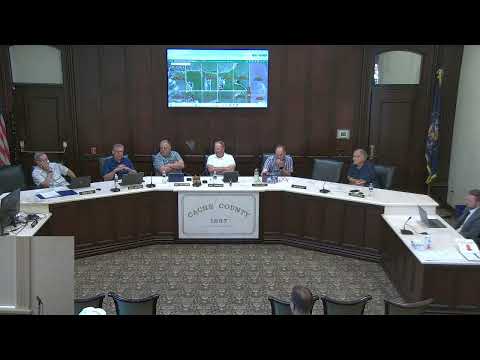
Cache County planning staff presented a revised short‑term rental ordinance at the Planning Commission’s July 9 meeting, prompting sharp debate over scope and enforceability.
The draft, released to the commission at county council’s request, defines a short‑term rental as a residential dwelling unit (primary or accessory) renting for fewer than 30 days and requires a certificate of occupancy from the building department. Staff said the draft would require conditional‑use permits in several rural zones (RE‑2, RE‑5, A‑10, FR‑40 and resort recreation zones), prohibit short‑term rentals in commercial and industrial zones, limit rentals to one per parcel, and require owner occupancy for the property to qualify as a short‑term rental.
“Owner occupied means it’s their primary residence,” staff said, explaining that the rule would exclude second homes and vacation properties except for a narrow exception for cabins in FR‑40 zones. The draft would also require an approved site plan showing on‑site parking at a ratio of one space per bedroom, prohibit street parking, require annual physical fire inspections rather than self‑inspection, mandate on‑site signage listing maximum occupancy and a local contact available 24/7, and set revocation procedures with a one‑year reapplication bar.
Commissioner comments focused on how restrictive the proposal is and whether it addresses the county’s practical enforcement capacity. “This seems very restrictive,” one commissioner said, noting that rules such as prohibiting street parking and mandating round‑the‑clock contact could exclude many legitimate owner‑operators and retirees seeking supplemental income.
Dirk Howard, who spoke during the public comment period, asked whether the draft targets commercial operators or would also impede homeowners seeking off‑grid or small‑scale installations. Howard said, “Is this primarily looking at commercial applications, or how does it impact a homeowner trying to set up solar to be in an off grid?” (staff answered that small, roof‑mounted systems would generally be unaffected). [Note: Dirk Howard’s question concerned the solar item but commissioners raised similar owner‑occupancy concerns for short‑term rentals during the same meeting.]
Several commissioners argued that bad actors who run party houses or large events could instead be regulated under the existing recreational‑facility/CUP process. Others urged the county to consider a hybrid approach that favors business licensing plus annual fire inspections and a business license‑suspension process as a faster enforcement lever than the lengthy CUP revocation process.
Deputy Executive Kurt Webb told the commission to weigh enforcement capacity when drafting the code. “If we sit down and write down what we want to enforce most, this isn’t going to rise to the top,” he said, urging the commission to consider how feasible enforcement would be before finalizing the ordinance.
Commissioners also flagged several practical issues staff should research: whether detached accessory structures should be allowed as short‑term rentals (current ADU rules prohibit detached ADUs), how to count occupancy for properties on private roads, how septic capacity and water rights should factor into occupancy limits, and which fund receives room‑tax (transient‑lodging) revenue when collections occur at the county level.
Action and next steps Commissioners asked staff to gather prior materials, complaint records, enforcement data and examples from other jurisdictions (Washington County and Logan City were cited as reference models). The commission requested a workshop or joint session with the county council and fire, roads and clerk’s offices to clarify enforcement, taxation and operational expectations before moving the draft forward.
What’s next Staff will compile the requested background and coordinate a follow‑up workshop and a draft that addresses the commission’s enforcement and property‑rights concerns; no ordinance vote occurred at the July 9 meeting.