Get Full Government Meeting Transcripts, Videos, & Alerts Forever!
Get email alerts on the Attorney General Authority topic
No spam. Unsubscribe anytime.
Cochise County supervisors ask county attorney to probe whether Arizona attorney general overstepped in Benson recycling-plant intervention
Summary
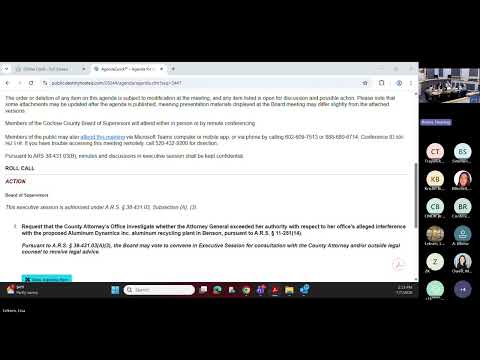
On July 7 the Cochise County Board of Supervisors asked the County Attorney's Office to investigate whether the Arizona Attorney General exceeded her authority in intervening in the proposed Aluminum Dynamics Inc. (ADI) Benson recycling plant and other local business matters; the motion, amended to cover businesses countywide, was approved by voice vote.
Cochise County supervisors voted on July 7 to ask the County Attorney's Office to investigate whether the Arizona Attorney General exceeded her authority when intervening in local business matters, including actions tied to the proposed Aluminum Dynamics Inc. (ADI) recycling plant in Benson.
The motion, introduced and read by the meeting chair, directed the County Attorney's Office to review relevant statutes (the transcript cites "ARS 11 2 51 14" and Title 41), gather public records and communications, and report back with findings and recommendations. Supervisors then amended the motion to broaden the investigation to alleged interference with businesses lawfully operating anywhere in Cochise County before approving the measure by voice vote.
Why it matters: Board members said the Attorney General's interventions, and threats to use the public nuisance statute, are chilling local economic development and risk deterring employers from investing in Cochise County communities. Supervisors said they want legal clarity on the limits of the Attorney General's authority so cities such as Douglas and Benson can pursue employers and job-creation projects with confidence.
What the board said: The chair characterized the Attorney General's actions as using the nuisance law "as an offensive mechanism" rather than a protective shield and urged the county to explore legal remedies, including the possibility of asking a court to rule on the statute's scope. The chair said, in describing ADEQ's reply to the Attorney General's request, that ADEQ had told the AG the permit process "followed the law," that ADEQ extended public notice periods beyond the state minimum and had held community meetings and hearings, and that ADEQ would not at that time reopen or interrupt the EPA review.
The chair also read from an ADI press release saying the company decided not to proceed in Benson and will instead develop the facility in Mississippi; the press release said timing and the anticipated need for recyclable aluminum slabs beginning in 2027 factored into the decision. The chair told supervisors he wanted records of communications between the Attorney General's office and ADI and between the AG's office and ADEQ.
County Attorney's Office response: A staff representative told the board the office can conduct public-records searches, seek communications between the AG's office and the business, and partner with interested pro-business groups to build a record of what occurred. The staff member said the county had previously held an executive session when initial news about ADI's cancellation surfaced and that the office's legal advice about next steps had not changed.
Claims and context: Board members compared the ADI case to a prior dairy matter in which, according to comments in the meeting, a threat of nuisance litigation prompted settlements described in the transcript as totaling about $11,000,000, presented as two $5.5 million disbursements (one described as going to a local nonprofit and one to an escrow oil-mitigation fund); those figures were cited in the meeting transcript but not documented in materials provided to the board at the hearing.
Action taken: The board approved the amended motion directing the County Attorney's Office to investigate whether the Attorney General exceeded her authority with respect to alleged interference with lawfully operating businesses in Cochise County, to pursue public records retrieval and research, and to return to the board with findings and recommendations. The transcript records the approval by voice vote; individual roll-call votes and tallies were not recorded in the meeting transcript.
What happens next: The County Attorney's Office will undertake the records searches and legal review requested by the board and report back with its findings and recommendations; the board scheduled a separate 3:00 p.m. meeting the same day to discuss a conflict-of-interest matter with a previously retained attorney.
Quotes (selected): "I move that we request the County Attorney, investigate whether the Attorney General exceeded her authority with respect to her office alleged interference with the proposed Aluminum Dynamics'aluminum recycling plant in Benson pursuant to ARS 11 2 51 14," the chair said when moving the original motion.
On ADEQ's handling of the permit process, the chair summarized ADEQ's response: "The permit process was followed exactly to the law. As a matter of fact, we extended the 60 day public notice period... We included both an informal community meeting as well as formal public hearings." A County Attorney's Office staff member added that records the office receives "is available to the public."
Claims matrix (examples): - Chair alleged the Attorney General used nuisance threats to extract concessions from businesses and may have exceeded statutory authority; the board directed an investigation. - ADI, via a company press release cited in the meeting, said it chose to develop at an alternative location because of differences with Arizona state officials; the company's relocation decision was presented as described in ADI's press release. - ADEQ, as paraphrased by the chair, stated it followed statutory permitting procedures, extended public notice and would not reopen or interrupt the EPA review at that time.
Limitations and notes: The board quoted statutes and a specific ARS citation as stated in the transcript; the meeting transcript contains typographical and phrasing inconsistencies (for example the ARS citation and some agency acronyms) and does not include a full roll-call vote record for the motion. The transcript also referenced settlement figures in a prior dairy matter without attaching supporting documentation; the County Attorney's Office investigation may clarify those points.
By the book: The board's directive requests research and records review rather than an immediate legal filing; supervisors said they expect the County Attorney's Office to return with a recommendation on legal remedies and next steps.
Ending: The meeting concluded with the board scheduling a 3:00 p.m. meeting to discuss a conflict-of-interest matter; the County Attorney's Office will proceed with the investigation requested by the board.