Get Full Government Meeting Transcripts, Videos, & Alerts Forever!
Get email alerts on the Winter Maintenance topic
No spam. Unsubscribe anytime.
Sawyer County highway staff warns winter maintenance could near $1 million as salt costs rise
Summary
Highway staff told the Public Works Committee that rising rock‑salt prices and an expected 4,200‑ton purchase to fill sheds have pushed this year’s winter maintenance budget from about $712,000 toward $1,000,000, and members asked staff to compile cost comparisons and options including salt‑sand mixes and brine.
Highway department staff told the Sawyer County Public Works Committee on the meeting’s highway report that sharply higher rock‑salt prices are pushing the county’s winter maintenance costs well above the budgeted amount.
“Our winter maintenance budget’s around $712,000… I’ve increased it this year and you haven’t seen it yet, but almost up to 1,000,000 dollars,” the highway department staff said, adding that salt now costs about $109.74 a ton and the county needs roughly 4,200 tons to fill its sheds. “That’s almost 500,000 right there,” the staff member said.
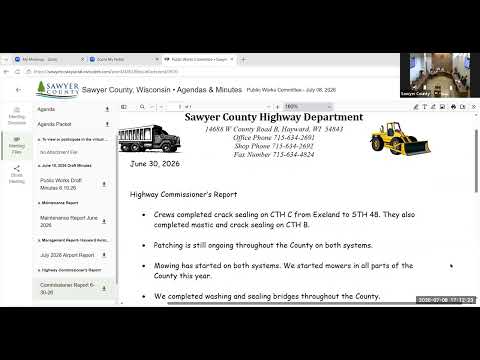
The presentation covered ongoing road work — crack sealing, patching and pulverizing on County F — and scheduling notes that paving is expected to start Aug. 10 after a change at the supplier’s plant. Staff said the pulverizing work on County F has covered about three miles and should be finished with grading by the next Tuesday. A public involvement meeting for the Radisson–Winter road section was announced for July 13 from 6–8 p.m. in the village of Radisson.
Committee members asked whether alternatives could reduce long‑term costs. One committee member raised the prospect of targeting salt‑sand mixes to low‑traffic roads to cut spending; the highway staff said a 50/50 salt‑sand mix is used on low‑ADT roads elsewhere and can provide earlier traction, though it still takes longer to clear than pure salt. The staff also discussed pre‑wetting salt and potential brine use but cautioned that adopting brine requires capital investment in trucks and brine makers and would not immediately produce savings.
“We can still keep doing what we’re doing,” the highway staff said, “but I just want to bring it to your attention that salt did increase quite dramatically, and I don't see it going down.”
Members asked staff to collect comparative cost data from other counties and to model trade‑offs — equipment and facility costs for a brine system versus recurring salt purchases and road impacts. The committee directed staff to return with several options and cost comparisons to inform policy choices in future meetings.
The committee did not take a formal vote on changes to winter‑maintenance practice at the meeting; staff were asked to provide numbers and implementation options for follow‑up discussion.