Get Full Government Meeting Transcripts, Videos, & Alerts Forever!
Get email alerts on the Disaster Response topic
No spam. Unsubscribe anytime.
Story County opens state disaster assistance after storms; emergency management urges residents to apply
Summary
Story County emergency management reported 11–12 inches in Maxwell and Cambridge and more than 300 homeowners reporting damage after July storms; state disaster case advocates and Iowa individual assistance were opened and residents are urged to apply via StoryCountyIowa.gov.
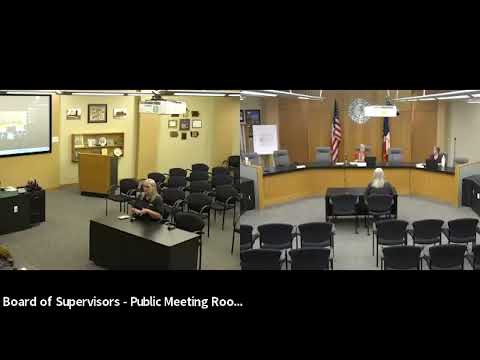
Melissa Spencer, a Story County emergency management official, told the Board of Supervisors on July 7 that an extraordinary storm event overnight brought widespread flash and some river flooding across the county and that state assistance programs have been opened for affected residents.
"We have just over 300 individual homeowners that have reported damages to their home here in Story County," Spencer said, describing rainfall of 11 to 12 inches in Maxwell and Cambridge and about 6 inches across a swath from Ames to Colo. She said both flash flooding and river flooding occurred, and that flash flooding caused the greatest community impacts.
Spencer said Iowa Homeland Security approved opening the disaster case advocacy program and the Iowa individual assistance program after a governor's proclamation signed the day before. "The disaster case advocacy program is open to everyone. There are no income restrictions," she said, adding that advocates will help residents develop recovery plans and identify other services.
The Iowa individual assistance program includes an income eligibility threshold and a reimbursement cap. Spencer said the state program applies to households at or below 200% of the federal poverty level and that eligible applicants may receive up to $7,000 in reimbursement for documented expenses. "They have to show receipts for what they've spent, but there is a maximum of a $7,000 benefit that's available," she said, and clarified that the payment is a grant, not a loan.
Spencer explained that reporting damage to the county does not equal applying for assistance: damage reports help officials estimate the scale of impact for a potential federal disaster declaration, while separate applications are required for state programs. She urged residents affected by flash flooding or other impacts to apply and said application links and reporting forms are posted on StoryCountyIowa.gov and the Story County Emergency Management webpage.
On public infrastructure, Spencer said jurisdictions must document roughly $480,000 in cumulative damage to qualify for public-assistance programs; county and municipal staff were asked to return rough estimates by the end of business the following day to help the state determine whether to pursue federal assistance. "We're collecting those numbers and asking the jurisdictions to provide me rough estimates by tomorrow," she said.
Spencer also praised the county engineer's office for beginning damage assessments and said about six to seven roads had been reported with some damage, although dollar estimates were not yet available. She noted additional rain in the forecast and reviewed the difference between flash flooding (short-term, surface-runoff events) and river flooding (longer-duration rises), saying Story County's creeks and rivers often rise and fall quickly.
Board members thanked emergency management for outreach and frequent alerts. Spencer said the county is sharing information with local media, and reiterated the websites where residents can find application and reporting links. The board did not take any formal action beyond accepting the briefing; jurisdictions will continue compiling damage estimates.