Get Full Government Meeting Transcripts, Videos, & Alerts Forever!
Get email alerts on the Historic Preservation topic
No spam. Unsubscribe anytime.
Urbana council rejects landmark designation for Civic Center after debate over transit hub
Summary
After hours of presentations and public comment, the Urbana City Council voted down an ordinance to designate the Urbana Civic Center (108 E. Water St.) a local historic landmark, setting the stage for continued negotiations over a proposed Champaign‑Urbana Mass Transit District transfer facility.
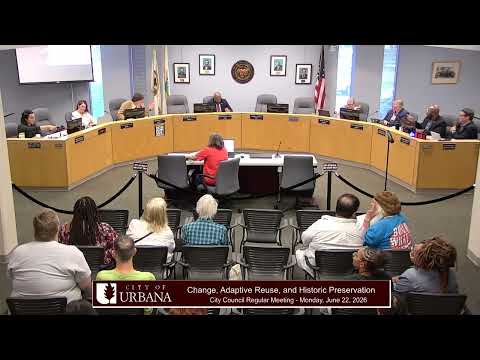
The Urbana City Council voted down an ordinance to designate the Urbana Civic Center at 108 East Water Street as a local historic landmark on June 22 after extended testimony from preservation advocates, an architect urging adaptive reuse, MTD officials and dozens of residents.
The vote on ordinance 2026‑06‑016 failed on a 4‑2 roll call (Evans, Wilkin — yes; Wu, Hersey, Jones, Quisenberry — no), leaving the council without the local landmark protections sought by the Historic Preservation Commission and preservation advocates.
Preservation commission member Kate Holiday told the council the commission had not been meaningfully included in the federal Section 106 review process and urged the council to consider rehabilitation and design options that preserve character while allowing new uses. “Historic preservation today is not what it was 20 years ago,” Holiday said, urging collaboration and saying the commission is ready to “work with the public” and to pursue rehabilitation strategies that allow additions and upgrades.
An architect who presented adaptive‑reuse diagrams, Joseph Altschuler, told councilors the Civic Center — which he said occupies roughly 8,394 square feet on an 82,000‑square‑foot site — could be incorporated into a transit facility using partial demolition, bridging or wrapping strategies. “There’s a beautiful opportunity for us to bring many stakeholders to the table,” Altschuler said, and he offered examples showing how the existing structure might anchor a larger transfer center.
MTD managing director Carl Gannett pressed a contrasting view. He said MTD has concept plans and operational requirements that the existing building footprint and vehicle circulation constrain, particularly for 60‑foot articulated buses and on‑site layover. “The building gets in the way,” Gannett said, noting MTD had paused some activities to respect the public process and that the pause had cost a grant opportunity. He said the agency wants a facility that improves safety and accessibility for riders and that the site was vetted over many years.
Public commenters split broadly: preservation advocates, including Phyllis Williams and Susan Apple of the Preservation and Conservation Association of Champaign County, argued the building meets multiple landmarks criteria and urged careful deliberation. Disability and transit advocates, including Sarah Rand and others, said a dedicated transfer terminal would improve ADA access, reduce passenger exposure to weather and consolidate confusing on‑street stops.
Council members expressed competing priorities. Several members voiced concern that landmarking could delay or complicate MTD’s plans and a potential $32 million grant for a downtown transfer center; others emphasized the public‑asset nature of the site and the need for transparent community engagement. Council discussion repeatedly returned to two procedural points: (1) whether Section 106 notifications and NEPA steps had given the Historic Preservation Commission meaningful notice and (2) whether adaptive reuse had been sufficiently explored with cost and engineering data.
The failed motion leaves the council and stakeholders with unresolved options. Several council members and staff noted the city’s Capital Improvement Plan currently includes an estimated $700,000 for demolition but also said demolition need not occur immediately and could be revisited if grant funding does not materialize.
Next steps mentioned at the meeting include possible intergovernmental agreements if MTD pursues a purchase or lease of city property, further technical studies (including preservation‑focused cost estimates and detailed site engineering), and continued public engagement. The council did not adopt restrictions on the property during the meeting; the debate is likely to continue as MTD and preservation advocates seek points of compromise.