Get Full Government Meeting Transcripts, Videos, & Alerts Forever!
Get email alerts on the Defense Research topic
No spam. Unsubscribe anytime.
Presenter says DARPA offers unstructured, high-reward work with unusual field access
Summary
A presenter described working at the Defense Advanced Research Projects Agency (DARPA) as "one of the most rewarding experiences," saying projects often have "no roadmap" and offering examples such as launch challenges, ship and submarine visits, an F-16 flight and a speech at the U.N. in Vienna.
A presenter at a public talk described working at the Defense Advanced Research Projects Agency (DARPA) as "one of the most rewarding experiences," and said applicants should "throw your hat in the ring" because the work is often open-ended. "There will be no roadmap for what you're going to do when you get here, and that is maybe the most exciting part," the presenter said.
The presenter gave an example of the agency's open-ended projects: an internally developed launch challenge to "try to launch rockets from, like, random unprepared places," a concept he said staff must invent procedures for as they go. He framed that improvisational approach as central to DARPA's mission of pursuing high-payoff research that does not fit within conventional program structures.
He also emphasized DARPA's close engagement with military users, saying staff spend time with service members to learn "their operational challenges and what is the equipment and the situation that they operate with today" so research better aligns with operational needs.
The presenter recounted several experiences that illustrate that operational engagement, saying staff have "got to go on the deck of an aircraft carrier, get a tour inside a nuclear submarine," and that he had an opportunity to "fly in the back of an F-16" and to "speak at the UN in Vienna." He said those experiences are part of what makes the work distinctive.
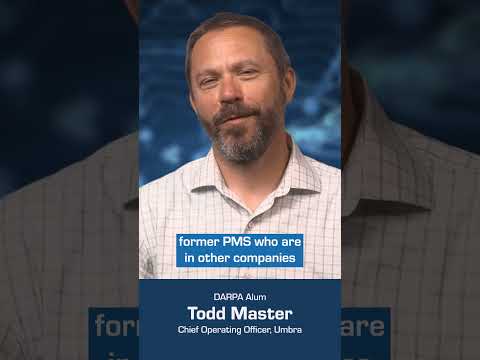
He described an ongoing professional network among former program managers who now work in industry, saying they keep a text thread to exchange ideas and "bounce things off of each other." Despite working on separate portfolios, he said program managers are "office mates" with a common management chain and mission, and that a few times a year they meet as a group to set priorities: "What should the office be focused on? Like, what's happening in the world? What's happening in technology?"
The presenter said those periodic meetings "build those bonds between program managers" and help staff know one another better. He characterized the combination of unstructured challenges, operational contact and regular strategic planning as both professionally demanding and deeply rewarding.