Get Full Government Meeting Transcripts, Videos, & Alerts Forever!
Get email alerts on the Property Tax Reassessment topic
No spam. Unsubscribe anytime.
Allegheny County committee hears testimony on bill to require property reassessments every three years
Summary
At a public hearing, Allegheny County Council members, school leaders and residents debated a proposal to mandate countywide property reassessments every three years; proponents said regular reassessments would improve fairness and reduce costly appeals, while some homeowners voiced concern about abrupt tax changes and asked for more outreach and protections for seniors.
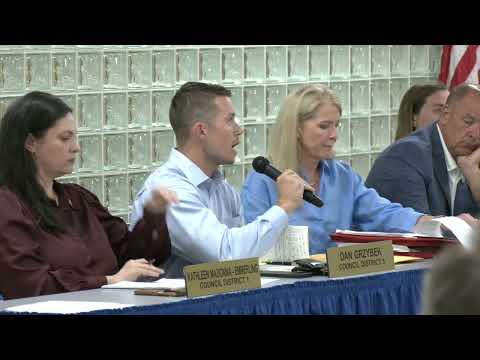
Suzanne Filiagi, chair of the Assessment Practices Committee of the Allegheny County Council, opened a public hearing at a CCAC campus, saying the session was one of seven the council will hold on a proposal to require countywide reassessments every three years. She told attendees that written comments are being accepted and that the council wants to gather input before finalizing the measure.
The bill’s sponsor, Councilman Grisbeck, told the committee the ordinance would mandate continuous reassessments on a three‑year rolling cycle. Grisbeck said Allegheny County is an outlier for not conducting routine reassessments and argued modern computer‑aided mass appraisal methods could perform the work faster and at far lower cost than older door‑to‑door models. “If we did that, we'd be looking at a total bill of probably 40 to 50 million dollars for that reassessment that would obviously eventually be borne by the tax,” Grisbeck said, later adding that a computerized model could reduce that to “a couple million dollars.”
Jack Billings, who described himself as an economist and research committee chair for housing management, urged the council to adopt regular reassessments for reasons of fairness and efficiency. “Allegheny county has not done regular countywide assessments in nearly 50 years and that is costing residents real money every year,” Billings said. He estimated that the status quo costs residents “tens to hundreds of millions of dollars per year” in mispriced taxes and argued that automated valuation approaches could lower annual reassessment costs toward the low‑millions rather than the tens of millions required by a full field operation.
Rob Ostrander, president of the West Allegheny school board, described district impacts from the county’s current assessment system, saying the district has lost assessed valuation and has reimbursed taxpayers after appeals. Ostrander said those valuation shifts translate into reduced revenue for schools: “Since 2023, Western Allegheny has lost nearly 270 million in assessed valuations. That equates to $4.5 million in [annual revenue].” He told the committee that regular reassessments would not increase overall county revenue (because state law requires revenue neutrality) but would reduce appeals and make local budgeting more predictable.
Becky Campanero, speaking as a Mount Lebanon resident and elected school‑board member, emphasized how small, landlocked districts are constrained by the Act 1 index and by changes in the common level ratio (CLR). “Regular reassessment is not about raising taxes. It's about restoring fairness, transparency and accuracy to a system that's really no longer working as intended,” she said, adding that Mount Lebanon's taxable real estate value had declined by $21.5 million since 2019 even as homeowner sale prices rose.
Several residents raised concerns about timing and individual impacts. Brenda, a homeowner and U.S. Army veteran, said she had “no appetite” for raising taxes and asked whether a three‑year cycle was necessary. Council members and staff repeatedly responded that state law requires revenue neutrality when reassessments take effect and that most property owners would see millage rates adjusted so that total tax collections do not produce a windfall. Council members also offered to provide one‑on‑one property lookups, referencing a public lookup tool compiled by proponents.
Council members explained the common level ratio and recent litigation that affected it, saying the CLR had fallen sharply after a court challenge involving non‑arm’s‑length transfers and that the decline has shifted tax burdens and increased appeals. Grisbeck said the CLR would effectively reset to 100% in the year a reassessment takes effect and argued that regular reassessments would prevent the large, unpredictable shifts that occur when assessments are infrequent.
Committee members acknowledged political sensitivity and said outreach is needed to explain the technical details and protections for long‑term homeowners; they cited the Long‑Term Owner‑Occupancy (LOOP) program as one safeguard to limit sharp increases for qualifying owners. No vote was taken; the committee will accept written comments and hold additional hearings before any formal committee action.
The committee scheduled more public hearings across the county and asked residents to submit written comments; Suzanne Filiagi said written comments would be accepted through Aug. 24 (she also referenced a second nearby date during remarks). The committee said it will continue briefings with experts and review public input before amendments or a formal committee discussion.