Get Full Government Meeting Transcripts, Videos, & Alerts Forever!
Get email alerts on the Caregiving topic
No spam. Unsubscribe anytime.
Pima Council on Aging details caregiver programs, partnerships and funding tactics in ACL webinar
Summary
Representatives of Pima Council on Aging explained how they use partnerships, bilingual outreach, a for-profit home-care arm and diversified grants to expand caregiver supports — including memory cafes and workforce training — during a webinar hosted by the Administration for Community Living's National Caregiver Support Collaborative.
During a webinar hosted by the Administration for Community Living's National Caregiver Support Collaborative, Pima Council on Aging officials described how they build and sustain a network of caregiver supports through community partnerships, targeted outreach and diversified funding.
"More than 63,000,000 family caregivers provide most of the support that makes it possible for older adults and people with disabilities to live in the community," said Jonathan Weston, aging services program specialist with the Administration for Community Living, in opening remarks that framed the session's emphasis on strengthening the aging network.
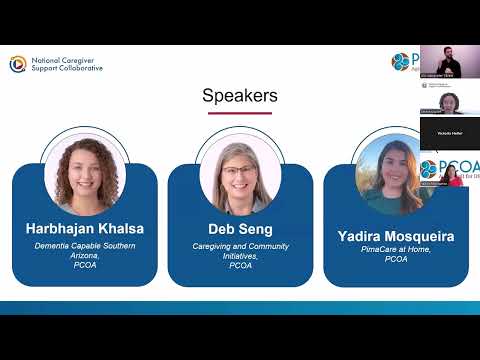
The presenters from Pima Council on Aging (PCOA) outlined a multi-pronged approach centered on five pillars: information and assistance (including a helpline), meals and nutrition, caregiver support and education, in-home services and long-term care support, healthy aging and advocacy and community planning. "We act as a service planner, coordinator, purchaser, provider, and advocate," said Harbajan Khalsa, director for Dementia-Capable Southern Arizona at Pima Council on Aging.
Why it matters: PCOA serves a county of roughly 1,000,000 residents with notable Spanish-speaking and Hispanic populations; officials said reaching caregivers where they live and in languages they use is central to equitable access. "We strive to have as many bilingual staff as possible and provide as many services in English and Spanish," Khalsa said.
Programs and expansion PCOA staff described dementia-specific services such as memory cafes and a hub model that trains other organizations to run cafes locally. "We launched two cafes ourselves, and then created a hub model so we could expand — now we have nine throughout Pima County with plans to add more, including in rural Ajo," Khalsa said. The panel credited an ACL grant for helping scale the hub approach.
Workforce and training PimaCare at Home, a for-profit company owned by PCOA established in 2010, supplies short- and long-term nonmedical home care and acts as a state-certified training provider for direct care workers and caregivers. "Revenue from private-pay clients and contracts is given back to Pima Council on Aging so that funds can be used across programs," said Yadira Mosquera, director of PimaCare at Home. The organization also operates a skills lab aimed at simulating home settings for hands-on training.
Outreach and messaging To reach people who may not self-identify as caregivers, PCOA described community events and a media campaign. Deb Tseng, caregiver and community initiatives director, highlighted a caregiver appreciation festival held in November (national caregiver month) that brought together social-service agencies, local businesses and volunteers; PCOA estimated donated time and goods for the event between $5,000 and $10,000. Tseng also described an "Am I a Caregiver" media campaign using radio, TV, print and social media to surface caregivers — including long-distance and rural caregivers — and connect them with supports.
Partnerships and funding strategy Panelists stressed partnerships as a key to reaching diverse populations and sustaining services. Khalsa and colleagues cited collaborations with United Way of Tucson and Southern Arizona, the Pima County Health Department, Chicanos Por La Causa, YWCA and the Intertribal Council of Arizona. "Don't be afraid to ask questions or to seek clarity, but just be as creative as you can be," Khalsa said.
On funding, PCOA emphasized diversification: Older Americans Act funds, ACL grants, foundation grants, managed care organization contracts, municipal funds, VA partnerships and private pay. Khalsa noted the dementia program is currently 100% grant-funded and urged that organizations collect demographic and outcomes data to demonstrate impact when applying for support.
Practical takeaways and next steps Panelists urged organizations to "bring a friend" to expand partnerships, leverage local institutions (utilities, United Way) for modest sponsorships, and build bilingual offerings to match community demographics. The webinar closed with resources posted in chat and a planned follow-up summary from the National Caregiver Support Collaborative technical assistance center. Emma Koploff, the session facilitator, said the recording, slides and materials will be available on the Collaborative's website and encouraged attendees to sign up for the listserv and complete the event survey.
Sources: Remarks and presentations by Jonathan Weston (Administration for Community Living), Harbajan Khalsa (Pima Council on Aging), Deb Tseng (Pima Council on Aging) and Yadira Mosquera (PimaCare at Home) during the ACL National Caregiver Support Collaborative webinar.