Get Full Government Meeting Transcripts, Videos, & Alerts Forever!
Get email alerts on the Resilience topic
No spam. Unsubscribe anytime.
County staff and consultant outline start of Resilient Florida adaptation plan
Summary
Jones Edmonds consultant Brett Cunningham briefed commissioners on the Resilient Florida adaptation plan: it follows the county's vulnerability assessment, focuses on public assets and four county focus areas, aims to be grant‑ready, and will supply cost estimates in the final report due Feb. 27.
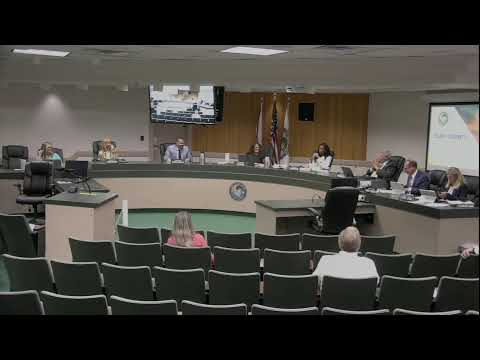
At the June 23 meeting, Brett Cunningham of Jones Edmunds presented an overview of Clay County’s Resilient Florida adaptation plan, the next phase after the county’s vulnerability assessment.
Cunningham said the Resilient Florida program (established by state legislation in 2021) funds planning grants and implementation grants. Clay County’s vulnerability assessment identified roughly 13,000 public and regionally significant assets to be evaluated for exposure and sensitivity; the adaptation plan will focus on prioritizing projects for public assets and regionally significant facilities.
He identified four focus areas that emerged from the assessment — the St. Johns River area, Black Creek, Middleburg and Lake Asbury — and said the adaptation plan will be made grant‑ready so the county can follow up with implementation grant applications. Cunningham emphasized that the planning work concentrates on publicly owned or regionally significant assets (for example hospitals) and is not intended to address private individual homeowner vulnerabilities. He also said staff will develop project cost estimates as part of the final adaptation plan; the presentation indicated the final report is due Feb. 27 of the next year.
Commissioners asked technical questions about the meaning of sensitivity rankings, examples of critical infrastructure (wastewater/water treatment plants, lift stations and culverts were mentioned) and when state grant windows typically open. Cunningham said the planning grant window typically opens July 1 and remains open for about 90 days, and clarified that implementation grants generally require a local match (often 50%). He urged commissioners to identify priorities early so the adaptation plan can focus on the county’s highest‑priority public assets.
Next steps: the county will hold additional public meetings, take commissioner and staff priorities, and produce a final adaptation plan intended to support grant applications for infrastructure, drainage, monitoring and hardening projects.