Get Full Government Meeting Transcripts, Videos, & Alerts Forever!
Get email alerts on the Historic Preservation topic
No spam. Unsubscribe anytime.
New Canaan subgroup considers "intent to demolish" filings and longer review delays to protect historic homes
Summary
A Charter Review Commission subgroup in New Canaan debated procedural changes — including a simple "intent to demolish" filing, expanding a 90‑day delay to 180 days, and pursuing Certified Local Government status — to give preservation bodies earlier notice and more tools to keep historically significant houses from disappearing.
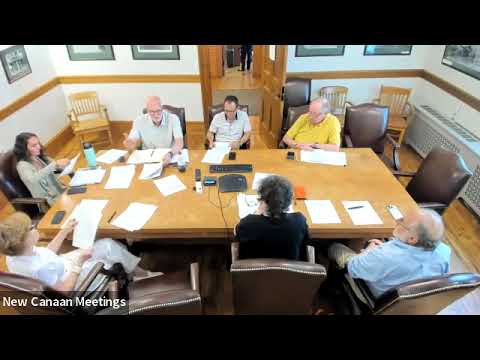
A Charter Review Commission subgroup meeting on July 1 in New Canaan focused on ways to give preservation reviewers earlier notice of potential demolitions and to strengthen town coordination for historic preservation.
The subgroup, meeting as part of a broader review of preservation and conservation issues, discussed a proposal to require a short "intent to demolish" filing with the building department before a full demolition permit is sought, a change that members said would allow the town and preservation groups more time to evaluate a property's significance.
"We don't have a role" in stopping most single‑family demolitions, Sarah Perry said, explaining planning and zoning's statutory limits. "Statutorily speaking, we have...no enforcement authority. We don't review demolition applications." Her comments framed much of the discussion about where in the town process preservation review could realistically be added.
Members flagged several practical gaps. One participant noted the current civil penalty for unauthorized demolition is small: "It's a $500 fine," a remark that underscored concerns that the penalty does little to deter preemptive teardown. Participants also described how the town often learns of redevelopment plans late in the design process, after developers have advanced plans with contractors.
To address those gaps, members proposed three complementary steps: 1) create a short, mandatory notice of intent to demolish submitted to the building department so the clock and notification to preservation bodies can begin earlier; 2) consider lengthening a commonly used 90‑day review delay to a maximum of 180 days in relevant ordinances; and 3) compile a town list or survey of locally significant properties so preservation reviewers and the public can know which buildings merit closer attention.
Several speakers urged a focus on education and incentives rather than strict new property restrictions. "Any sort of effective change really needs to come from coordinated...education and mindset changes," Steve Case said, framing the effort as one of community outreach as much as regulation. The group discussed state incentives and grant opportunities, noting that Certified Local Government (CLG) status and state tax credits can unlock funding for surveys and preservation work.
Members cited regional examples for practical models, naming Stanford, Westport and Norwalk as places that had organized preservation programs and stronger coordination with the State Historic Preservation Office. Several participants recommended speaking with state CLG coordinators and the Preservation Alliance to learn about survey methods, funding and implementation.
There was no formal ordinance change at the meeting. Instead, the subgroup agreed on near‑term next steps: circulate a one‑page set of concrete action items, reach out to the State Historic Preservation Office about CLG eligibility and grant prospects, and draft a simple intent‑to‑demolish form that the building department could use to notify review bodies earlier in the process.
The subgroup also asked the Historic Review Committee and the Historic District Commission to consider compiling or updating a publicly accessible list of historic properties and to discuss whether the town should staff or otherwise support that work. The meeting closed with members volunteering to follow up and the chair saying he would circulate a redraft of recommended action steps.
Minutes were approved earlier in the meeting and the subgroup adjourned at the end of the session.