Get Full Government Meeting Transcripts, Videos, & Alerts Forever!
Get email alerts on the Emergency Preparedness topic
No spam. Unsubscribe anytime.
Agency official briefs Fairfax County residents on thunderstorm preparedness after Burke microburst
Summary
A Fairfax County emergency management presenter reviewed the June 22 Burke microburst, urged residents to sign up for Fairfax Alerts and National Weather Service warnings, explained local/state/federal disaster-declaration steps and FEMA limits, and gave insurance and neighborhood-preparedness guidance.
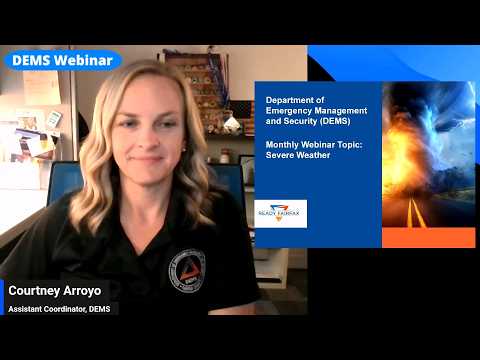
An agency official from Fairfax County Emergency Management told attendees of a July webinar that the county's recent Burke storm was a powerful microburst, not a tornado, and used the event to walk residents through alert signups, disaster declarations and recovery options.
The presenter said the Burke event produced "about 90 mile an hour winds" and clarified that radar showed no rotation, so the National Weather Service did not issue a tornado warning. She stressed that thunderstorms can arrive suddenly, produce strong winds and localized flooding, and often cause power outages that should be reported promptly.
Why it matters: Strong, fast-onset wind events can leave households displaced and slow recovery. The county emphasized layered alerts and household preparedness to reduce response times and streamline requests for outside aid.
Fairfax Alerts and other warnings: The presenter urged residents to register for Fairfax Alerts, the county's public alerting system, and explained it lets users add up to five addresses (for example home, school or workplace), choose which alert types to receive, and set a "do not disturb" window that suppresses noncritical messages (true emergency alerts will still be delivered). She said weather alerts in the county system are pushed from the National Weather Service and described reverse 911 and Wireless Emergency Alerts (WEA) that target subscribers in affected geographic areas.
Disaster declarations and FEMA: The speaker outlined the escalation process: incident response begins locally, the county collects damage assessments and, if local resources are overwhelmed, it can request state support through the Virginia Department of Emergency Management; if state support is insufficient, the county can seek a federal disaster declaration to make FEMA individual assistance and disaster recovery centers available. She answered attendee questions directly, saying FEMA was not providing recovery assistance for the Burke incident because Fairfax County had not qualified for or requested a federal disaster declaration.
Insurance and recovery steps: The presenter recommended residents perform an insurance checkup to ensure they have appropriate dwelling and personal property coverage and a record of household contents. She described Additional Living Expense (ALE) coverage that may help pay hotel costs, food and pet boarding for displaced residents and recommended carrying ALE coverage for as long as possible — she suggested 18 months as a conservative target for coverage duration.
Coverage specifics: The presenter distinguished dwelling coverage (repairs to the structure: roof, walls, windows) from personal property coverage (contents) and offered a rough rule of thumb for contents valuation: about $10,000 per room, while noting this can understate value for high-end items and that residents should inventory valuables and consider endorsements for antiques or jewelry.
Community preparedness: The county promoted Ready Fairfax programs and a five-step neighborhood guide workshop to help neighbors coordinate plans, and the presenter highlighted mutual aid observed in Burke after the storm as an example of community resilience.
What's next: The presenter closed by inviting attendees to the August webinar on school safety and how to talk to children about safety without causing alarm.
Quote: "Ready Fairfax is our preparedness program," the agency official said, and urged listeners to sign up for local and National Weather Service alerts.
Sources and limitations: All quotes and policy descriptions come from the county webinar presentation. The presenter named Fairfax Alerts, the National Weather Service and the Virginia Department of Emergency Management as sources of alerts and coordination. No formal actions or votes were taken at the webinar; FEMA assistance was described as unavailable for the Burke event because no federal declaration had been requested or approved.