Get Full Government Meeting Transcripts, Videos, & Alerts Forever!
Get email alerts on the Elections Redistricting topic
No spam. Unsubscribe anytime.
New Haven registrars outline mapping-and-notification plan after redistricting misassignments
Summary
City registrars and counsel told the Board's CSIP committee they are overlaying pre- and post-redistricting maps to identify addresses moved between state house districts and will send targeted mailings to residents who "may have been affected"; committee members and civic groups urged an independent audit and clearer public messaging before the Aug. 11 primary.
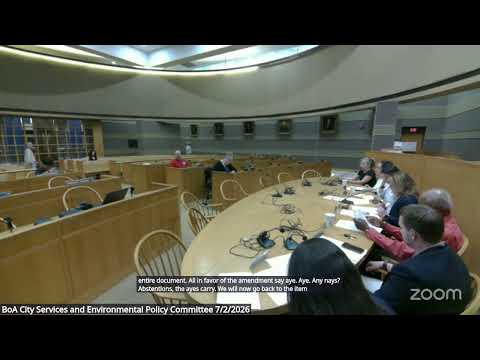
City registrars and legal counsel told the New Haven Board of Alders' City Services and Environmental Policy Committee on July 2 that they are working with the secretary of state and local IT to identify residences that were assigned to the wrong state house districts after the 2021 redistricting and to notify affected households ahead of the August primary.
Attorney Robert Williams, who has advised the registrars, said the state's CBRS voter-registration system does not hold a straightforward history of address changes, so local staff will "take the map from pre-redistricting, overlay it with the existing map, identify the residences and addresses that have been moved to a different district and send it" to those households so they know they "may have been affected by the redistricting." He said the secretary of state's office has reported corrections to CBRS and confidence that the upgrades will prevent a repeat of the problem.
Why it matters: Committee members and civic groups said the scale of the error is unusually large and has consequences beyond single elections. "The numbers that we are talking about in New Haven are very unusual," said Patricia Rossi of the League of Women Voters of New Haven, urging a full review. Public testimony and committee discussion referenced two public figures for the problem's size: roughly 432 addresses cited by state staff and a higher, less-certain estimate of about 744 voters reported in public analyses.
What officials told the committee: City Clerk Michael Smart summarized election logistics and the new no-excuse absentee process, and registrars described operational steps: overlaying maps, working with IT to identify affected residential addresses (including apartments), and preparing both general postcards and a targeted second mailing to households flagged by the overlay. Williams said the office aims to meet the "spirit" of a recently passed statute requiring notification to affected voters within 90 days if an error is discovered, even though the statute is new and its full application has not yet been triggered in an affected statewide election.
Calls for independent review and clearer public messaging: Council members and several public witnesses urged a formal audit and broader outreach. Erin Good of the New England Votes Coalition warned of downstream effects, from candidates who unknowingly ran in the wrong district to potentially invalid nominating committee actions. Witnesses and aldermen suggested using existing city GIS, university statistics or geography departments, or the state's voter-technology center for an independent technical review.
Process and next steps: Registrars said they are working with IT to finish the mapping and will mail targeted correspondence to households flagged by the overlay. The committee asked for follow-up briefings and records (vendor outputs, cross-off lists and the mapping results); it kept the item open for further oversight. No formal change to election dates was proposed; the primary remains scheduled for Aug. 11.
Quotations: "We're working with IT to identify the residences and addresses that have been moved to a different district and send it not just as ... a postcard to everybody, a separate communication is gonna go out to those addresses we identify saying you may have been affected," Attorney Robert Williams said. "There were, yes, there were little mistakes in other municipalities, but there were not 774," Patricia Rossi of the League of Women Voters said, urging a review. "July 1 a new... no-excuse absentee ballots went into effect," Erin Good told the committee, underscoring the need for voter education.
What remains unresolved: Officials and counsel said they cannot yet provide a full, itemized list of addresses and exact counts until IT completes the overlay. Committee members also asked for vendor records and a clearer explanation of why previous, smaller errors (e.g., 28 voters on one street in 2023) were not addressed more aggressively at the time.
The committee kept the matter open and requested follow-up materials and further briefings once the mapping and IT checks are complete.