Get Full Government Meeting Transcripts, Videos, & Alerts Forever!
Get email alerts on the Fleet Street Reconstruction topic
No spam. Unsubscribe anytime.
Portsmouth committee reviews Fleet Street one‑way proposal with contraflow bike lane under study
Summary
Public Works presented a plan to make Fleet Street one‑way from Congress to Hanover to widen sidewalks and add pedestrian signals; staff said a 6‑ft contraflow bike lane is possible if parking is reconfigured and grading allows. The proposal will go to City Council for final decision.
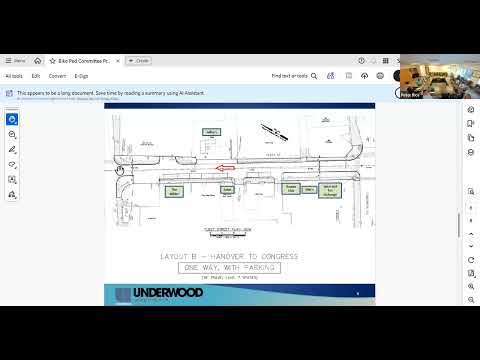
Eric Eby, a driving engineer with the city’s public works department, told the Portsmouth Bike & Pedestrian Committee that the preferred design for the Fleet Street reconstruction is to make the block between Congress and Hanover one‑way from Congress to Hanover while keeping on‑street parking and widening sidewalks to ADA standards. “The winning choice is really to make the street one way flow from Congress to Hanover Street,” Eby said during the committee’s meeting.
Eby described an 18‑foot travel lane that could either be left as a single wide travel lane or restriped to a 12‑foot lane with a 6‑foot contraflow bicycle lane allowing two‑way bicycle traffic while motor vehicles travel one way. He said crews will install a new signal at the Congress–Fleet intersection with dedicated pedestrian pushbuttons and a bicycle signal head so bicycles using the contraflow lane would get a lead or protected interval. “Because of the changes to the traffic flow at the intersection, we are putting in a new traffic signal,” Eby said. “There is a bicycle signal head on the mast arm, which would be just for the bicycles coming this way on Fleet Street.”
Committee members raised operational and safety concerns that staff said they will study. Matt, a committee member attending by Zoom, said contraflow bikeways can be useful but warned of conflicts between moving cyclists and parked cars, noting the potential for dooring and curbside movements. “The more streets that are one way, the harder it is [for bicyclists],” Matt said. He urged staff to explore shifting parking to the opposite curb to place parked cars between the travel lane and a contraflow bike lane. Eby acknowledged that arrangement would be safer for cyclists and said staff will investigate whether parking can be shifted, given existing curb grades and ramp locations.
Staff showed the proposed striping and curb geometry and said the option on the table preserves several short‑term parking spaces at the Congress end of Fleet Street (seven shown on the plan) while shortening pedestrian crossings near the Franklin Block. Eby said the option emerged after public surveys conducted in 2021–22 and discussion at the city’s Parking, Traffic & Safety committee. He added that a traffic model shows the one‑way flow will perform, with diverted vehicle trips redirected around the block to Maplewood or Market Street without undue delay.
No formal committee vote was taken; Eby said staff plans to present the same materials to City Council at its July meeting and expects council will make the final determination on one‑way vs. two‑way for this section. If council approves the one‑way plan, construction and signal installation are scheduled to begin this fall with completion and sidewalk work finished the following year. “We will be going to the city council at their next meeting in July to present basically the same presentation here and why we're recommending the one way flow,” Eby said.
What’s next: Staff will study parking reconfiguration feasibility, finalize signal details (including whether to add the bicycle signal head), and return with updates to the committee; the committee will offer feedback to be included in the City Council presentation. The committee did not adopt a formal position at this meeting.