Get Full Government Meeting Transcripts, Videos, & Alerts Forever!
Get email alerts on the Building Energy Codes topic
No spam. Unsubscribe anytime.
Becca, GOER staff, outlines Massachusetts’ three-tier building energy codes and fossil-fuel-free pilot
Summary
At a MESM Academy training, Becca of GOER explained Massachusetts’ three-tier structure—base, stretch and specialized—how towns opt in via town meeting, and a fossil fuel–free pilot that tests an all‑electric pathway; she described thermal requirements, Passive House and incentives such as Mass Save.
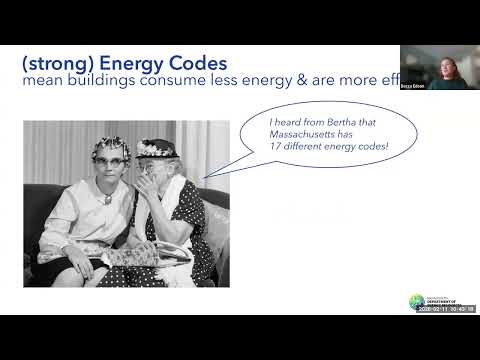
Becca, a staff member at the Governor’s Office of Energy Resources who works on building decarbonization, told municipal officials at a virtual MESM Academy training that Massachusetts operates three tiers of building energy code—base, stretch and specialized—and that a fossil fuel–free pilot is being used to gather data on an all‑electric pathway. "So, in Massachusetts, we have 3 tiers of energy code," she said, and described the stretch code as IECC 2021 with Massachusetts amendments in 225 CMR chapters 22 and 23.
Why it matters: Becca said stronger codes reduce building energy use, lower peak demand as the state electrifies and help meet the state’s net‑zero-by‑2050 goals established in 2021. She highlighted four thermal‑performance pillars—quality envelope, reduced air infiltration, energy‑recovery ventilation and thermal‑bridge mitigation—and said those elements make electrification more feasible and grid friendly.
Details from the training: Becca explained that the base code remains in place for roughly 50 municipalities, the stretch code (the primary voluntary upgrade) applies to new construction, major alterations and additions, and the specialized code builds on the stretch code with two appendices (residential "RC" and commercial "CC") and an all‑electric pathway that applies only to new construction. "If you're in a fossil fuel free community, basically, you could think of it as all as the specialized code all electric pathway," she said, describing the pilot as a way to collect data because participating communities have implemented the approach with local variations.
On verification and incentives: Becca said Passive House certification provides third‑party review that is helpful to overburdened local building departments and noted that in specialized‑code towns, multifamily housing is expected to meet Passive House standards. She reviewed modeled‑pathway approaches—Passive House, Teddi (Thermal Energy Demand Intensity) and HERS—saying Teddi is commonly used for municipal buildings and HERS is specific to dwelling units. Becca also pointed to Mass Save incentives for all‑electric Passive House multifamily projects and noted those per‑unit incentives are helping to drive market uptake; she cited an approximate figure of 23,000 passive‑house housing units (noted as possibly out of date).
Process and appeals: Becca walked through the local adoption process—town meetings or city council votes—and stressed communities must move from base to stretch before adopting specialized code. She also explained that appeals and variances for energy‑code waivers are handled by the Building Codes Appeals Board (BCAB) under BBRS, while GOER develops and supports the stretch and specialized code materials.
Next steps: Becca invited attendees to contact her for follow‑up help with code interpretation, modeling issues or building‑department review, and the moderator paused the recording to open a live Q&A.