Get Full Government Meeting Transcripts, Videos, & Alerts Forever!
Get email alerts on the Land Use topic
No spam. Unsubscribe anytime.
Seabrook planning commission revises land-use element, removes urban-growth-boundary paragraph and forwards edits to council
Summary
The Seabrook Planning Commission approved a set of edits to the town's land-use element, including striking language about a parcel's development capacity, deleting a paragraph on the county urban growth boundary, and adding clarifying language that proposed future uses are illustrative; staff will forward the revised draft to town council for final action.
The Seabrook Planning Commission voted at its meeting to adopt multiple revisions to the town's land-use element and to forward the revised draft to the town council for final consideration.
Tyler, the town's planning and zoning director, opened the discussion by asking commissioners to review the updates and explain their purpose: "We are asking the planning commission to review and provide a recommendation on several revisions and updates to the land use element of the comprehensive plan," he said, noting council had approved Ordinance 2026-01 at first reading to add a plan development district to the Development Standards Ordinance and that a second reading is scheduled for April 28.
Why it matters: The edits collectively clarify the town's planning intent, correct data errors and add procedural guidance for future rezoning. Commissioners said those changes aim to protect community character while leaving room for negotiated, site-specific approvals where appropriate.
Key changes and decisions - Data correction: Staff identified a GIS error in the existing land-use figures. Tyler reported the sole mixed-use site (the marina property) was listed as roughly "50 something acres" in prior figures; the corrected value is "about 4 point something acres." The correction was incorporated into the draft.
- Plan development district (PD): The draft adds a PD option to the land-use element and the zoning map. Commissioners and staff discussed the difference between the conventional mixed-use district (an enumerated list of permitted uses and standards) and a PD (project-specific, negotiated uses, setbacks, phasing and conditions). Tyler explained PDs are intended to provide flexibility while preserving review steps: staff review, planning commission recommendation, public hearings and two council votes.
- Clarifying language about illustrative options: Several commissioners, including Debbie, pressed staff to make clear that the lists of potential future uses for particular properties are examples only and do not constitute preferred or recommended outcomes. "I wouldn't want anybody to take it like that," Debbie said; the commission agreed to add qualifying language to the element to that effect.
- Striking a sentence on page 92: Commissioners voted to remove a sentence that described a particular parcel as "capable of accommodating more substantial new residential development." The motion to strike the sentence passed by voice vote.
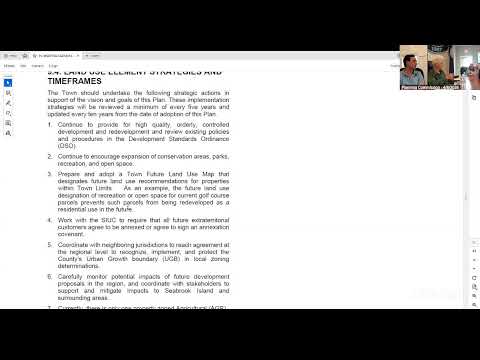
- Urban growth boundary (UGB) paragraph removed: A lengthy discussion about Charleston County's urban growth boundary and whether the plan should assert that UGB-intended intensities are inappropriate in Seabrook Island culminated in a motion to delete the disputed paragraph on page 98; the commission approved the removal. Commissioners said interjurisdictional coordination (for example, a regional statement of preferred future land-use goals) is a preferable path to address the underlying concerns.
- Strategies and timeframes: The commission added a policy action directing staff to "coordinate with neighboring jurisdictions to establish regional future land-use goals and implementation methods." Commissioners also discussed, and asked staff to consider in future DSO amendments, requiring pre-application meetings for rezoning requests (or at least for upzoning requests) and conducting a study of maximum allowable densities across zoning districts.
Process and next steps: Commissioners agreed to a final administrative review: staff will meet with the chair to confirm the edits, then distribute the signed draft for a short review period before forwarding it to town council. Tyler indicated the council had already adopted the planning commission's recommendations at first reading of Ordinance 2026-01 and that the second reading is scheduled for April 28.
What commissioners said: Commissioners repeatedly emphasized that the element should provide guidance, not mandates. One commissioner summarized the tone of the changes as providing a "menu" of potential future uses and priorities for staff and future decision-makers rather than locking in a single outcome.
The meeting concluded after the commission voted to accept the draft as revised and to have staff proceed with the chair's sign-off and onward transmittal to council. The meeting then adjourned.