Get Full Government Meeting Transcripts, Videos, & Alerts Forever!
Get email alerts on the Utilities topic
No spam. Unsubscribe anytime.
Punta Gorda City, Utility Advisory Board back consultant-recommended 12% water-wastewater rate increase; propose higher reserves
Summary
Finance and utility staff reviewed the FY2027–2031 utilities capital improvement program and recommended moving forward with a consultant-recommended 12% rate increase (to be presented as a resolution in September) and increasing the utilities operating reserve from $3.1 million to roughly $3.7 million.
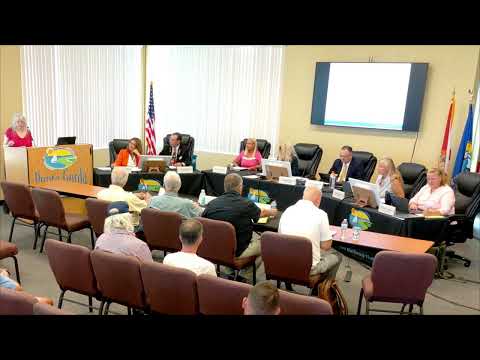
Punta Gorda City finance and utility officials reviewed the proposed fiscal year 2027–2031 utilities capital improvement program (CIP) and operations budget on July 8, and signaled consensus to bring a consultant-recommended 12% rate increase to the council in September while proposing that the utilities operating reserve be raised from $3.1 million to about $3.7 million.
Finance Director Kristen Simeone, presenting the utilities CIP and operations fund update to a joint session of the City Council and Utility Advisory Board, said most projects on the plan began in FY2025–26 and that only one project on the FY2027–2031 plan is newly added. She outlined funding sources including transfers from the operations, maintenance and rehabilitation (O&M/R) fund, estimated grants, state revolving fund (SRF) financing and bank financing. "First, that we're okay with the 12% increase, based on what the consultants have recommended for fiscal year '27," Simeone said, asking the board and council for consensus to proceed with rate resolutions in September.
Simeone described SRF support for several large projects, saying the financing assumptions show roughly a 50/50 split between loan forgiveness grants and SRF loans at 0% interest for items currently shown in FY2026. She also noted a $1,000,000 state grant toward advanced metering infrastructure (AMI) equipment that will be included in the final proposal.
On capital and operating needs, Simeone said the CIP includes a $1.1 million renewal and replacement allocation covering water main renewals, valve work, gravity sewer and lift station projects, inflow abatement and force mains, plus periodic utility relocations tied to road or county projects. She cautioned that the septic-to-sewer project estimates are older and that the project may be pushed later in the program until updated design and assessment-district work are complete.
The presentation covered operations assumptions used for budgeting: consultant rate assumptions of 12% for FY2027–2029 and 5% for FY2030–2031; estimated personnel merit increases of 4%; a health-insurance estimate of 8.5% (staff said recent insurance renewals came in at 5.5% and adjustments will be made for the final budget); and an annual unspecified equipment placeholder of about $700,000 for later years. Simeone also said wastewater impact fees are projected to begin contributing to wastewater revenue in FY2027 as the wastewater treatment plant improvement comes online.
On staffing, Simeone said a trainee position at the wastewater treatment plant was reallocated to an administrative assistant for fleet to improve fleet paperwork and free mechanics to perform maintenance, and a water distribution maintenance worker was reclassified to a hydrant technician. "It's more of just a title change, ensuring that that person is being utilized just for that one purpose," Tom Spencer, Utility Director, said when asked about cost impacts.
Council member Janine Polk queried a $75,000 line item labeled for an "additional lobbyist." Tom Spencer said the utility department is budgeting that as its direct cost to maintain an established relationship and to pursue funding opportunities; he clarified the city already contracts one lobbyist and this item would be an additional, department-funded engagement.
On reserves, Simeone recommended raising the minimum utilities operating reserve, currently set at $3.1 million, to better reflect inflation and operating cost volatility. She suggested setting reserves by a percentage or targeting a higher flat-dollar amount and gave a two-month operating reserve estimate of about $3.7 million (with three months as a further option). Members signaled support for at least incrementally increasing the reserve.
No formal votes were recorded on rates or reserves during the session; Simeone said the city would bring formal rate resolutions to the council in September for approval. Utility Advisory Board Chair Dave Abdrolden publicly commended Utility Director Tom Spencer for his work on the utilities program during closing remarks.
What's next: Staff will prepare formal rate and reserve proposals for council consideration in September and continue design updates and grant-financing work on projects such as the septic-to-sewer conversion and AMI deployment.