Get Full Government Meeting Transcripts, Videos, & Alerts Forever!
Get email alerts on the Stormwater Management topic
No spam. Unsubscribe anytime.
Dunwoody ZBA defers driveway and stream‑buffer variance at 4600 Briarwood after neighbors cite flooding
Summary
After extended public comment about chronic flooding and requests for hydrologic review, the Dunwoody Zoning Board of Appeals voted 5–1 to defer a decision on a driveway encroachment into the city’s 75‑foot stream buffer at 4600 Briarwood Place so staff and the developer can work on stormwater mitigation and engineering measures before the September meeting.
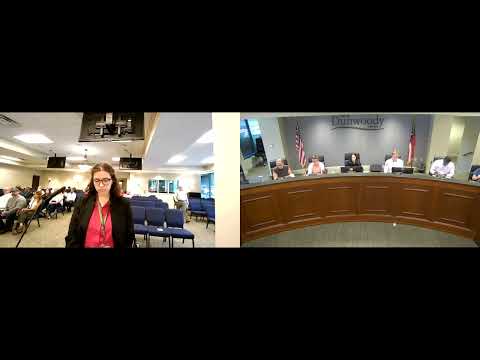
The Dunwoody Zoning Board of Appeals on July deferred a request to allow a driveway to encroach into a 75‑foot stream buffer and a contextual‑setback exception for 4600 Briarwood Place, after multiple neighbors described recurring flooding, basement damage and channel erosion and asked the board to require further study before approving a variance.
Staff presented ZBA26-13 and recommended approval on the grounds that the lot is highly constrained (0.33 acres, heavily wooded, a stream crosses the southwest corner) and that without a driveway the lot lacks a practicable access route. Applicant William Brackbill (speaker 11) told the board that the property was platted under DeKalb County when the state buffer was 25 feet and that a 75‑foot city buffer adopted later left the lot largely inside the protected area. He said his plan locates the house outside the 75‑foot buffer and skirts the buffer edge with a driveway to reach the buildable area.
Neighbors, however, urged caution. Frank O'Neil (speaker 10) said the creek is a major stormwater conveyance and requested a hydrologic study; Samantha Gold (speaker 15), Lindsay Beaulieu (speaker 14), Haley La Flame (speaker 16) and Peaches Sansom (speaker 17) described repeated basement flooding, documented videos of storm surges, and argued that even modest additional impervious surface could worsen downstream flooding. Several neighbors proposed alternatives such as converting the lot to green space or requiring more extensive mitigation.
Staff explained the local stormwater ordinance threshold (engineering review typically applies at 5,000 square feet of new impervious surface) and noted a modeled hydrology study for a project this small often shows negligible incremental impact. Staff also offered mitigation‑oriented conditions as possibilities (pavers or pervious material for the driveway, soil/infiltration testing, planting canopy trees, and a city engineer site inspection to identify any local conveyance blockages such as a failing concrete flume). The applicant said he will work with staff during permitting and said the proposed driveway grading generally follows existing contours.
After deliberation the board voted 5–1 to defer ZBA26-13 to the September meeting to give the city and developer time to propose and review water‑management measures and for staff to report back on feasible conditions. The motion directs the applicant and city staff to explore mitigation options (including site inspection by the city engineer, possible pervious paving or infiltration devices if soils permit, and erosion‑control measures) before the board considers the application again.
The deferral does not deny the variance; it schedules additional work and a follow‑up hearing. The board recorded the deferral vote as 5 in favor and 1 opposed.