Get Full Government Meeting Transcripts, Videos, & Alerts Forever!
Get email alerts on the Property Taxes topic
No spam. Unsubscribe anytime.
Jersey City council defeats measure to set third‑quarter estimated tax levy after public outcry
Summary
After hours of public comment denouncing a proposed property tax increase, the Jersey City Municipal Council voted unanimously to reject the administration's resolution to set an estimated third‑quarter levy tied to state transitional aid, leaving the final tax rate to be set during the upcoming budget process.
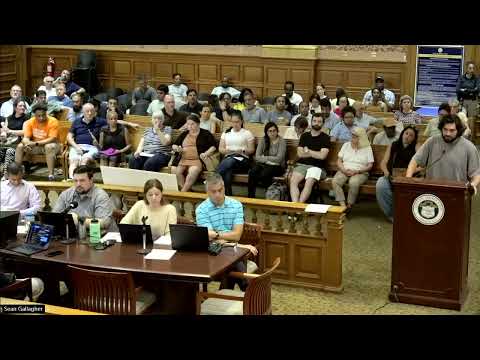
Hundreds of residents and dozens of speakers filled council chambers on July 1 as the Jersey City Municipal Council debated whether to authorize a higher third‑quarter estimated tax bill intended to spread this year's planned property tax increase across two payments. The council voted down the administration's resolution (No: 9; Yes: 0), after a long public‑comment period in which homeowners, renters and community groups warned that a double‑digit rise would be unaffordable.
The meeting began with more than three hours of public comment in which speakers repeatedly urged the council to seek spending cuts, better collection of existing fines and alternative revenues rather than imposing a 15% levy increase on residents. "We are driving people out of their homes," said Jeanne Stallman during public comment, arguing that repeated percentage increases will push longtime residents from the city. Dan Feldman told the council the city has a documented, unpaid obligation tied to a memorial lane and said enforcement of existing obligations could yield millions: "The city has collected $0," he said, urging the council to collect before taxing residents further.
Why it matters: the administration says the city discovered an approximately $255 million structural shortfall after taking office and secured a historic package of state aid that includes roughly $105 million in loaned transitional funds. Mayor (speaking role) told the chamber the Division of Local Government Services (DCA) reviewed the city's books and "in the opinion of the Division of Local Government Services" a 20% increase would be needed to balance recurring costs without mass layoffs; he said subsequent negotiations and local cuts produced a lower 15% option. "Last night is when we found out we were getting the $120,000,000," the mayor said, describing the timing constraint the administration cited for advancing an estimated rate now instead of only in the final budget.
Council members focused on two linked concerns: the immediate hardship for homeowners if the entire increase is pushed into the fourth‑quarter bill, and the legal/financial risk of approving a number without the detailed MOU between the city and DCA. Finance staff and council legal counsel repeatedly told the body that the state will memorialize the aid in a memorandum of understanding with conditions, and that DCA has broad authority to review or set tax rates where a budget or rate is not adopted. Finance staff warned that DCA's review has already looked at recurring liabilities and that some types of short‑term fixes (for example, deferring expenses to later years) are unlikely to be accepted by the state.
Councilmember Gilmore moved to amend the resolution to a lower estimated rate (spoken as 12% on the floor), but city finance officials said the levy calculation requires consultation with statutory officers and cannot be recalculated correctly on the spot. Corporation counsel likewise said the negotiation over MOU terms remains confidential while being finalized with DCA. Multiple council members said they preferred to delay formal authorization until the budget lines and any MOU terms could be reviewed in public.
What happened next: facing a council unwilling to adopt an amended figure without proper calculation and strong, sustained public opposition, the resolution authorizing the CFO to request DCA approval of the estimated billing increase failed by a 9–0 vote against adoption. Council members unanimously approved a separate motion earlier to go into a narrowly focused closed session to discuss privileged aspects of contract negotiations and litigation risk related to the MOU.
Context and next steps: By rejecting the resolution the council left in place the status quo for third‑quarter estimates; if no local rate is set, the administration says the final 2026 rate will be set when the full annual budget is adopted (expected to be introduced in July and final in August) and DCA will review and approve that budget. Council members and administration staff told the public they will continue budget hearings and work to identify recurring cuts and non‑property‑tax revenues (parking/traffic enforcement, contract renegotiation, asset strategies) that could reduce the final levy before the August adoption. The mayor and several council members also emphasized that DCA's aid package is conditional and that failure to reach terms could leave the state able to require a higher rate or trigger other interventions. The council scheduled follow‑up budget hearings and reconvened for July 15 at 6:00 p.m.
Who said it (select quotes): "We are driving people out of their homes," Jeanne Stallman told the council during public comment. Sarah Bernal urged that "residents deserve to know where the one‑time budget measures contributed to today's structural problems." Dan Feldman pressed the council to collect existing city claims before taxing residents: "Scan the card, read the record, then do the right thing. Vote no on this tax hike." The mayor told the chamber: "We opened our books to the Division of Local Government Services... they gave us the aid, but they also gave us some hard truths." Finance director (Bill) explained that DCA has broad authority and will review recurring costs before approving any long‑term plan.
What the record shows now: The council did not adopt the requested authorization to send a higher estimated tax levy to DCA. The administration will bring a formal budget introduction in July, with final adoption and a final tax rate in August; DCA will review the final budget and the MOU that defines loan terms. The council pledged extended budget hearings, continued outreach to state officials, and searches for recurring cuts and new non‑property‑tax revenue sources ahead of the August vote.
Ending: The meeting concluded after the defeated resolution and a final procedural adjournment; the council said it will reconvene July 15 at 6 p.m. to continue budget work and public hearings.