Get Full Government Meeting Transcripts, Videos, & Alerts Forever!
Get email alerts on the Housing topic
No spam. Unsubscribe anytime.
Downers Grove panel reviews housing survey and regional examples, urges zoning fixes and partnerships to expand attainable housing
Summary
Experts and municipal planners told the Downers Grove Planning & Zoning Commission that a mix of tools — inclusionary rules, housing trust funds, nonprofit partnerships, targeted zoning changes for ‘missing‑middle’ housing and measurable KPIs — will be needed to respond to local survey findings showing high cost burdens and limited starter‑home supply.
Flora Leon, senior planner for the Village of Downers Grove, opened the July 8 workshop by framing the session as a continuation of the village’s attainable‑housing study and turned the floor to the Metropolitan Mayors Caucus for a briefing on Phase 1 findings.
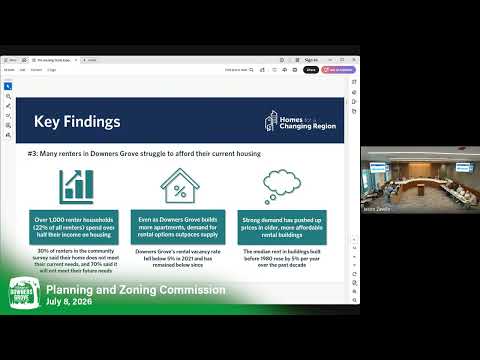
Ben Shnely, manager of housing and community development initiatives at the caucus, said the team’s outreach included a community survey with more than 900 responses and two focus groups. He summarized four key findings: Downers Grove’s senior population needs more downsizing options; starter homes for first‑time buyers are increasingly scarce as median home prices rose about 6% per year since 2012 while incomes rose roughly 3%; roughly 1 in 5 renter households (just over 1,000 households) spend more than half their income on housing; and the village’s large job base includes many moderate‑ and lower‑wage positions that lack nearby affordable options. “The first key finding is that Downers Grove’s seniors need more downsizing options in order to remain in the community over the long term,” Shnely said.
A three‑member practitioner panel followed, offering local case studies and implementation details. Alan Johnson, introduced from St. Charles, described that city’s housing commission and a housing trust fund that supports several programs: urgent home‑rehab grants (up to $20,000 for households at or below 60% of area median income), deferred‑payment loans for homeowners at 80% AMI, down‑payment assistance that pairs county and city funds, and an Affordable Housing Development program that leverages city trust dollars with Kane County financing. Johnson highlighted Prairie Center, a 27‑acre redevelopment that produced a 75‑unit senior affordable building (Anthony Place) as the city’s inclusionary success under negotiated terms.
“I think our preference would be to put that on the market — developers need to figure out how to incorporate affordable units in their projects,” Johnson said, describing a recent shift away from fee‑in‑lieu payments and toward on‑site units when feasible.
Nora, a retired planner who led housing work in Arlington Heights, reviewed her community’s long experience (a housing commission active since the 1970s) and the 2020 formalization of an inclusionary ordinance. She emphasized program design choices that matter for outcomes — whether affordability is required in perpetuity or for limited terms, downtown versus non‑downtown fee differences, and enforcement and monitoring — and urged examining actual units produced rather than only ordinance percentages.
Richard Koenig, executive director of the Housing Opportunity Development Corporation, described 40 years of nonprofit development experience across suburbs, presenting recent projects (stand‑alone affordable developments in Northbrook and McHenry County) and emphasizing long affordability terms and management by mission‑driven owners. “Our goal is in perpetuity because there's such a huge need for housing for people who have lower incomes,” Koenig said.
Dylan Rumsey of Opticos Design defined “missing‑middle” housing (house‑scale buildings such as duplexes, fourplexes and cottage courts that typically contain 4–12 units) and outlined zoning and cost barriers. He recommended targeted zoning text amendments, “test fits” to identify pinch points, preapproved building catalogs, and simplified ADU rules to expand feasible infill options while preserving neighborhood scale.
Public commenters raised infrastructure and safety concerns and asked how local decision‑makers would ensure projects do not overload roads, sewers, schools or emergency services. Jenna Lienyen, a resident, urged the village to consider those tradeoffs and asked how construction impacts on neighboring property would be addressed: “I’m wondering how those kinds of considerations are going to be addressed as this program might develop.” Panelists responded that incremental, targeted change, careful siting and coordination with service providers were appropriate next steps and that an in‑depth local analysis would be required.
Panelists and staff discussed funding strategies available to Downers Grove: participation in the DuPage County CDBG/HOME consortium, DuPage’s county housing trust fund (a prior $5 million allocation), and municipal trust‑fund models that partner with counties or nonprofits for underwriting and ongoing management. The panel recommended partnering with experienced nonprofit housing organizations to screen applicants, administer units, and handle monitoring and reporting to relieve municipal staffing burdens.
Commissioners pressed for measurable outcomes and performance indicators. Several experts suggested monitoring vacancy rates, production counts and how many local households move into newly created units as practical KPIs. Staff said the consultant team will publish a housing action plan with strategy recommendations and “bite‑sized” next steps and that the final report is scheduled for presentation to the village council on Aug. 18; it will be posted publicly the Friday before the council meeting.
No new ordinance or regulation was enacted at the workshop; the meeting concluded after public comment and a motion to adjourn that was seconded and approved by voice vote.
The consultant team and staff will incorporate feedback into the August report, with follow‑up work on zoning text amendments, ADU policy and potential nonprofit partnerships for unit management.