Get Full Government Meeting Transcripts, Videos, & Alerts Forever!
Get email alerts on the Comprehensive Plan topic
No spam. Unsubscribe anytime.
Franklin City Council adopts 2026 comprehensive plan after HWC presentation
Summary
The Franklin City Council held a public hearing July 6 and approved a resolution adopting the City of Franklin 2026 comprehensive plan after a presentation by HWC Engineering and brief public comment; the plan updates the 2013 guide and clarifies the future land use map is advisory, not zoning.
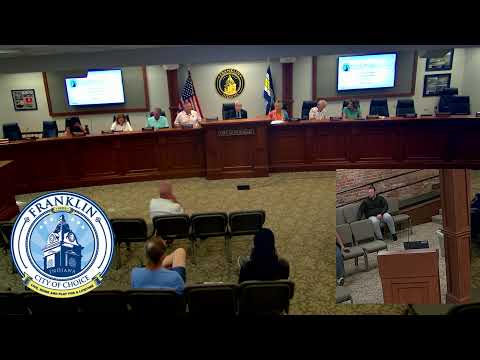
FRANKLIN — The Franklin City Council on July 6 voted to adopt the City of Franklin 2026 comprehensive plan after hearing a presentation from HWC Engineering and a brief public hearing.
Rachel Christiansen, planning studio lead at HWC Engineering, and Alec Poorman, project manager at HWC, presented an overview of the update and the firm’s community-engagement work. The plan, the presenters said, replaces the city’s 2013 comprehensive plan and lays out long-range guidance for land use, transportation, utilities and public facilities.
“The comprehensive plan is a long-range guide for development, redevelopment and community investment,” Christiansen said, describing the plan as “almost like your welcome mat for your community” that helps potential investors and policymakers align on a shared vision.
Poorman summarized outreach that informed the draft: public workshops, focus groups, an interactive online map and surveys, mobile display boards in city locations and a farmers-market pop-up. “Anything that you’re telling us here, anything in the survey, that is in one way or another going to make its way into this plan,” he said.
HWC emphasized that the future land use map inside the plan is advisory, not a zoning map, and does not compel property owners to change existing uses. “This is not a zoning map… If you have farmland, we want it to be farmland for the next 200 years,” Poorman said; staff added that an expanded proposed map on the east side gives the city guidance to consider if annexations or rezoning requests arise in those areas.
A resident asked for examples of changes from the 2013 plan; HWC pointed to a more district-based economic-development approach, additional public-engagement deliverables (including a brief “cheat sheet” summary of the plan) and modest municipal classification updates. One council member noted population projections in the plan that estimate the city could reach roughly 31,000 residents by 2050.
After brief council discussion, the council moved to approve a resolution adopting the comprehensive plan and approved it by voice vote. The record shows the council adopted the plan and thanked HWC staff for their work on the update.
The adopted plan will be used by council, the plan commission, the board of zoning appeals and city staff to guide future zoning and development decisions; separate zoning actions remain subject to later, formal requests and approvals.