Get Full Government Meeting Transcripts, Videos, & Alerts Forever!
Get email alerts on the Beach Development topic
No spam. Unsubscribe anytime.
Deerfield Beach commissioners debate replacing barrier-island charter protections with a simplified 65‑foot cap; public pushes back
Summary
Commissioners discussed replacing Article 11.01 with a 65‑foot maximum height, moving many development rules into the land‑development code and repealing some Main Beach Parking Lot limits; staff presented technical constraints and hundreds of residents urged preserving charter protections and a master plan.
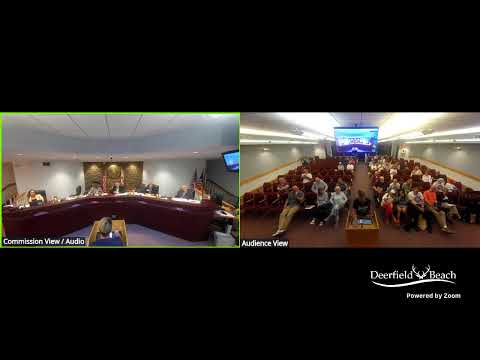
Deerfield Beach commissioners spent the July 6 workshop wrestling with proposed charter revisions that would change development rules for the Barrier Island, including a Charter Review Board recommendation to replace Section 11.01 with a 65‑foot maximum height and to move other standards into the city’s land‑development regulations.
Mayor Drozky opened the discussion by rejecting what he called misinformation online — including claims that the changes would allow “20 to 50‑story” towers — and argued the city needs flexibility to encourage reinvestment while protecting the island’s character. He said a 65‑foot limit could serve as a temporary backstop while the city develops a Barrier Island master plan.
Deputy City Manager Eric Power gave a technical presentation explaining how the charter, the land‑development code and flood‑elevation requirements intersect on the Barrier Island. Power described the zoning districts affected (B‑1, RM‑25 and RM‑10), showed how floor‑area ratio (FAR), lot coverage and finished‑floor elevation affect allowable building massing, and pointed out that FEMA flood‑elevation changes increase base finished‑floor heights — which in turn affects measured building height under the city definition.
Commissioners voiced differing views. Commissioner Plaut said height is the most visible concern for residents and favored keeping a charter height restriction but noted that variances have sometimes undermined the charter’s protections. Commissioner Preston said island residents should have “the loudest voice” and said he was wary of language that would “remove all” charter restrictions; he added he could live with a 65‑foot cap if it was part of a carefully crafted plan. Commissioner Shanetzky urged caution and slower study, warning of legal and infrastructure risks and the state’s Live Local law. Vice Mayor Hudak proposed keeping Article 11 in the charter but simplifying it to a 65‑foot maximum, FAR of 1.0 and 50% lot coverage while removing the provisions that bar mixed‑use retail on the first floor, arguing that modest tweaks would enable a village scale.
Hundreds of residents who signed up to speak urged the commission not to remove or weaken the charter protections. Speakers repeatedly raised the same themes: concerns about traffic and evacuation capacity, risks from increased density in a hurricane zone, preservation of the city’s “village” character, and distrust of giving developers more rights. Two recurring suggestions from the public were stronger code enforcement on neglected properties and a community‑led master‑planning process before any charter changes are placed on the ballot.
The commission did not vote on charter language. Mayor Drozky said there was not yet enough consensus to wordsmith ballot language and asked staff and the clerk to schedule a special workshop before the July 21 deadline for first readings; the city attorney reminded the commission that the timeline for placing questions on the November ballot is tight. The discussion will continue at a follow‑up meeting where commissioners hope to provide clearer direction to the city attorney and draft precise ballot language.
What happens next: the commission asked the clerk to arrange another workshop and flagged July 21 and August 4 as upcoming dates for first readings and votes; residents and commissioners indicated further public engagement and technical study will be necessary before any charter amendment is finalized.