Get Full Government Meeting Transcripts, Videos, & Alerts Forever!
Get email alerts on the Land Use Variance topic
No spam. Unsubscribe anytime.
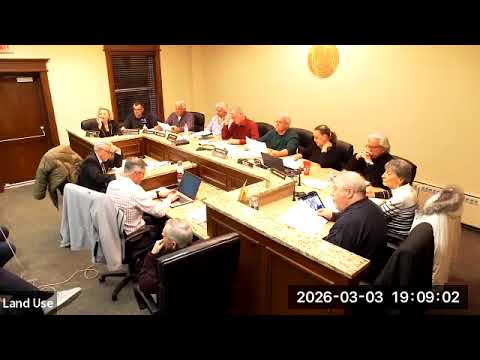
Hopatcong land-use board grants variance to let wall be rebuilt on subdivision line amid neighbor dispute
Summary
The Hopatcong Land Use Board voted to grant a setback variance allowing the applicant to reestablish a retaining wall on the subdivision line, contingent on moving the offending portion off the neighbor’s side and filing revised deeds removing easement language; the board directed counsel to submit the revised deeds and track the wall’s removal.
The Hopatcong Land Use Board on a motion and second approved a setback variance that will allow a property owner to reestablish a retaining wall on the subdivision line so long as the portion of the wall that now sits on a neighbor’s land is removed and the applicant submits revised deeds deleting easement language.
The action came during a continued application by Mark Annis concerning 247 Squat Trail, where prior approvals required a subdivision perfection and certain easement language. Applicant counsel told the board that removing the contested sliver from Annis’s lot would increase lot coverage from about 45.3% to roughly 46.9% — an increase of approximately 1.3 percentage points — and asked the board to modify the condition so the project can be closed out without attaching that sliver now. The board’s motion authorized a variance to allow the wall to be placed on the subdivision/property line rather than set back five feet as ordinarily required.
Neighbor Thomas L. Bondi, sworn to give testimony, said he had no objection to the applicant’s garage or other work but repeatedly stressed his objection to the retaining wall that encroached onto what he described as his land. "The only question … is the retaining wall that I object to," Bondi said, adding that he could agree to the project only if the wall were removed or if deed language afforded him enforceable protections.
Board members and the parties discussed practical remedies: moving the small portion of the wall off Bondi’s side, reconstructing a new wall wholly on the subdivided line, or tightening easement wording. Engineers and board members warned that partial removal or relocation could create steep slopes that might need engineering approvals and possibly soil-conservation or DEP review, depending on the reconstruction method.
The board asked the applicant’s counsel to prepare revised deeds that remove the easement language and to send copies to the board and to Bondi. Counsel agreed to "send you copies of the deeds" and revise the easement language. The board also asked staff to be notified when the wall work is scheduled so staff can track compliance. The motion passed when board members answered affirmatively during roll call.
The board did not attempt to force a deed-signing by Bondi; members noted the municipality lacks authority to compel another private party to sign a deed. Instead, the approval allows the applicant to proceed on his lot if he moves the offending portion of the wall to the subdivision line and perfects the subdivision documents consistent with the board’s instructions. The board indicated that, if the deeds or wall move did not happen in a reasonable timeframe, the parties could return to the board.