Get Full Government Meeting Transcripts, Videos, & Alerts Forever!
Get email alerts on the Affordable Housing topic
No spam. Unsubscribe anytime.
Highland Park planning board finds affordable‑housing ordinance consistent with master plan after debate on new development fee
Summary
The Highland Park Planning Board voted to find Ordinance 26‑21/27, updating local affordable‑housing rules to align with 4th‑round state standards, not inconsistent with the borough master plan. Members focused on new deed‑restriction timing, bedroom‑mix rules and a discretionary residential development fee; one member opposed the fee.
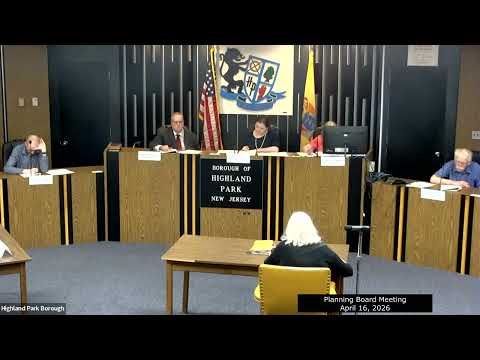
The Highland Park Planning Board voted on April 16 to find Ordinance 26‑21/27 — which updates borough code Chapter 86 to implement 4th‑round affordable‑housing rules — not inconsistent with the borough master plan.
The board heard a presentation from professional planner Elaine Clisham of Clark Kenton Henson, who described most changes as administrative updates required by the 4th‑round regulations but noted several substantive items the board should know. "Ninety percent of what you see here, you have in some form already," Clisham told the board, adding that the ordinance is intended primarily to ensure the town’s affordable units remain creditworthy.
Clisham flagged a new definition for "prior round unit," which matters because units approved in earlier rounds but not yet built would remain subject to their original control periods (30 years for 3rd‑round rentals), while 4th‑round rentals would carry 40‑year controls. She also described a new requirement for for‑sale developments that at least one affordable unit match each market‑rate product type present — for example, if townhouses are sold as market rate, the developer must provide at least one affordable townhouse.
The planner told the board the draft ordinance requires developers to submit a draft deed restriction before a building permit is issued, with a final recorded deed restriction replacing it at certificate‑of‑occupancy. "Prior to the issuance of any building permit, they have to provide a draft deed restriction," Clisham said, calling the change a response to past projects where recorded deed restrictions could not be located.
One of the ordinance’s larger policy shifts is a proposed residential development fee. Clisham said the fee would be 1.5 percent of the increase in equalized assessed value, determined by the tax assessor, and the borough proposes collecting the fee at CO. She said nonresidential development fees are statutory and in place since 2008, while residential fees are discretionary and could be tailored with exemptions or thresholds. "It's on the increase in value," she said of the fee calculation.
A committee member said the borough’s retroactive estimate showed the residential fee would have generated roughly $77,000 if it had been in place three years earlier, a figure provided to give the board a sense of scale. "It's about $77,000," the committee member said.
Board members debated whether the fee could discourage modest, 'missing‑middle' redevelopment the town seeks to encourage. One member said the fee was inconsistent with the master plan’s emphasis on promoting such housing; others argued the ordinance helps the borough remain compliant with affordable‑housing obligations and provides a trust‑fund revenue source to support affordability programs.
After discussion and a question‑and‑answer period — during which Clisham noted the fee can be adjusted (for example, by not charging small increases or by using other exemptions) — a member moved to find the ordinance not inconsistent with the master plan. The board conducted a roll‑call vote; most members voted yes, one member registered opposition, and the motion passed.
The board then returned to routine business, approving past meeting minutes with minor edits, and adjourned. The ordinance’s next procedural steps were not specified in the meeting transcript.
Sources: Testimony of Elaine Clisham, professional planner (Clark Kenton Henson); Planning Board member questions and roll‑call action at the April 16, 2026 Highland Park Planning Board meeting.