Get Full Government Meeting Transcripts, Videos, & Alerts Forever!
Get email alerts on the Volunteer Programs topic
No spam. Unsubscribe anytime.
Kiawah Island stewards begin season with training on species ID, leash rules and volunteer logistics
Summary
At a virtual meeting, program coordinator Cindy briefed Kiawah Island shorebird stewards on season timing, dog-leash rules, species identification and how to log volunteer hours; a walk with South Carolina DNR is planned for Sept. 26.
Cindy, the program coordinator for Kiawah Island’s shorebird stewards, told volunteers at a virtual training that the group’s top priority is protecting shorebirds and that outreach to beachgoers is a close second. “We’re here to protect the shorebirds,” she said, and added the program also focuses on teaching visitors why shorebird conservation matters.
The coordinator highlighted steep population declines to underscore the work’s importance: “Shorebirds have declined over 70% in the past 40 years,” she said, and noted that declines are worse for some species such as red knots. She said local stewardship efforts have measurable positive effects and are a key complement to regional conservation work.
Organizational and logistics details were front-loaded: the program year follows an Aug. 1–July 31 accounting window used by Audubon and the state DNR, and volunteers should submit hours via the program’s online form. Cindy said the program asks stewards to complete at least six hours across the season and that she can provide running tallies on request. She also gave the doc-box lock combination aloud for current volunteers and said laminated materials and ID tags will be distributed to new stewards.
Cindy reviewed rules stewards should know when talking with beach users. She said dogs must be on leash through Oct. 15 and may be off leash beginning Oct. 16, but owners still must keep dogs under control. She noted a permanent off-leash area runs from the Beach Club to the Ocean Course on the East End, while Beachwalker County Park on the West Side is a no-dogs area.
The meeting included a species-identification primer aimed at non-experts. Cindy walked through common fall/winter shorebirds and terns — brown pelicans, laughing and herring gulls, sanderlings and dunlin, piping plovers and oystercatchers — and offered simple field cues such as bill shape, leg color and behavior. “If you can learn the Sanderling and the Willet, those are good little two birds to help you kind of compare the other birds you’re seeing on the beach,” she advised.
Practical field guidance included where volunteers are most likely to find different groups: many species concentrate on the island’s East and West ends while the front beach (generally between the Ocean Course and Beachwalker Park) tends to host a smaller, more manageable set of species for new stewards. Cindy also encouraged a positive, non-confrontational approach: stewards should share friendly facts, avoid enforcement, and call beach patrol if a situation requires intervention.
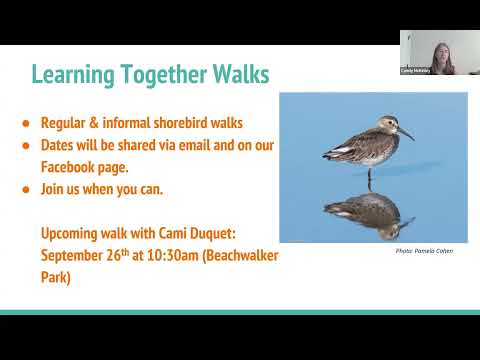
The program will host a guided walk with Cammy Duquette of the South Carolina Department of Natural Resources at Beachwalker County Park on Sept. 26 at 10:30 a.m., Cindy said; she will circulate details and a recording of the training by email. Cindy closed by asking volunteers to sign up for the season mailing list and reminding them to count any training or litter-cleanup hours toward their six-hour minimum.
The steering volunteer session ended with a reminder to wear steward shirts at public events and an invitation to participate in a Sand Castle litter cleanup connected with turtle patrol; Cindy said she will follow up with an email including links and materials.