Get Full Government Meeting Transcripts, Videos, & Alerts Forever!
Get email alerts on the Luca Tools topic
No spam. Unsubscribe anytime.
Census Bureau trains local officials on LUCA tools to check address counts before 2030 Census
Summary
U.S. Census Bureau trainers demonstrated how local governments can use the participant address list template, LUCA Geocoder, block count listing files and viewers to compare local address lists with Census counts and submit updates during the 2030 LUCA review.
The U.S. Census Bureau held a training webinar showing local governments how to prepare for the 2030 Local Update of Census Addresses (LUCA) review and how to use the agency’s geocoding and block-count tools.
Carrie Budicoffer, a team lead at the U.S. Census Bureau coordinating LUCA, opened the session and said LUCA is “an opportunity for tribal, state, and local governments to engage with the 2030 census by reviewing and commenting on the census address list prior to the 2030 census.” She emphasized the role of addresses as the census frame and noted that “trillions of dollars in federal funding are distributed each year using Census Bureau data.”
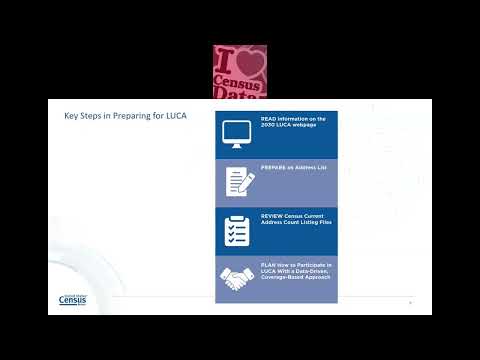
The training focused on four practical steps local governments can use to check and correct address records. Jonathan Phils demonstrated the participant address list template and its required fields — including a unique record ID and either a five-digit ZIP code or an entity GEOID — and walked through example records for city-style, non-city-style and group-quarter addresses. Phils explained how to convert the spreadsheet to a pipe-separated value (PSV) file and urged attendees to include subaddress identifiers (for example, Unit A or Apartment 1) rather than asterisks when an address represents a separate housing unit.
Tassio Acemakopoulos demonstrated the LUCA batch geocoding workflow on the Census Geocoder site, showing how a participant file is geocoded and written out as a Luca_geocoded PSV for use with the block count list tool. He said the batch LUCA Geocoder accepts files of up to 10,000 addresses and under 5 megabytes and recommended that larger address lists be split into batches or handled in GIS if needed. The block count list tool summarizes geocoded addresses by census block so local counts can be compared directly with Census block totals.
Using Excel and Power Query, Acemakopoulos then showed a step-by-step process to join participant block counts to the Census block count listing by Block GEOID, pull in the Census housing-unit and group-quarter counts with VLOOKUP, compute a difference column (participant minus Census) and sort to prioritize large variances for local review.
Peter Virgil demonstrated the Census viewers (address count listing files viewer and housing unit change viewer) and how to search by block GEOID. He cautioned that the viewer’s address search uses the ArcGIS World Geocoding Service, while the Census master address file is protected under Title 13. In examples from College Park, Maryland, Virgil showed blocks with large variances — including a block where the Census list showed 425 housing units while the participant count showed 17, and another with an 890-unit discrepancy — and explained that differences can stem from group quarters, recent construction, or missing subaddress entries.
The trainers recommended local governments take a layered approach: prepare a participant address list using the template, run batches through the LUCA Geocoder, export the geocoded results to the block count list tool, and then use the viewers and local knowledge (imagery, parcel records, building permits) to resolve discrepancies before making LUCA submissions. Key LUCA schedule points highlighted were initial contact in May 2027, training and preparation May–August 2027, LUCA review October 2027–March 2028, address-level feedback and appeals in March 2029, and confidential access through September 2029.
The Census Bureau provided the 2030 LUCA web page and a contact address for further questions (2030.LUCA@census.gov). The webinar concluded with an invitation to governments to begin preparing their address lists and to use the demonstrated tools to prioritize and document necessary updates for the 2030 LUCA review.