Get Full Government Meeting Transcripts, Videos, & Alerts Forever!
Get email alerts on the Local Development topic
No spam. Unsubscribe anytime.
Highland Park officials propose settlement with JSM to resolve Buckwoods contamination, expand housing and add community amenities
Summary
Borough staff presented a proposed settlement with developer JSM that would avoid direct borough payments for remediation, increase housing from the previously approved configuration, add a connector road, trail and small park, and require JSM to remove site debris; residents pressed officials on slope stability, health risks and parking.
Highland Park borough staff on Thursday presented a proposed settlement with developer JSM aimed at ending decades of litigation over debris dumped at the Buckwoods site and allowing the developer to proceed with an expanded residential project.
Joe, the borough attorney, summarized the litigation history and said the court previously found the borough responsible for the dumping. He told residents that JSM has site approvals for a 75-unit project but argued the company could pull permits and begin construction while the borough continued to litigate the amount of damages. "We were not gonna pay a nickel as a part of the settlement," Joe said, describing the borough's negotiating non-negotiables: no borough payment, no issuance of debt and no increase to the building envelope (height or footprint).
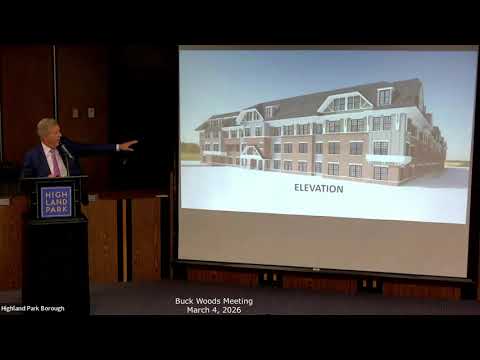
The settlement the borough team described would increase the number of units on the site while reducing average unit size (more one- and two-bedroom units) so the building exterior—the approved envelope—would not change. Officials said the developer agreed as part of negotiations to: build a connector road to provide two points of access instead of the current single entrance; construct a walking path linking the site to the Meadows Trail; create a small public playground/"tot lot" on a borough lot near the entrance; and provide enhanced landscaping to buffer adjacent residential streets.
Officials presented several financial and impact figures at the meeting. Joe said JSM originally sought roughly $6.26 million in remediation damages; borough counsel described work that reduced the exposure in litigation to roughly $5.3 million. Under the proposed settlement, borough staff said the municipality would avoid direct remediation payments and instead expect a net fiscal swing from avoided debt and a new pilot tax arrangement (estimated at about $500,000 in year one, rising over time). Staff also cited an estimated school impact of about 32 children and said the developer intends to provide 222 parking spaces across the project (a roughly 1.5-space-per-unit ratio as presented).
Residents raised repeated technical and safety concerns. One attendee who identified himself as a geologist warned that removing decades-settled slabs and debris "will completely destabilize the slopes," potentially damaging neighboring properties; the geologist said he expected removal to require significant stabilization work. Borough staff and the planning team responded that site stabilization will be part of the planning-board review, that engineers must sign off on slope work, and that the developer will be required to show how excavation and stormwater will be handled.
A tenant who said they live at 242 South 6 told officials they had not been informed the site near their building had been used as a dump and asked about health and groundwater risks. Borough staff said they were not aware of groundwater contamination based on existing testing and committed to follow up and confirm testing and public disclosures.
On traffic and parking, residents asked whether an increase from an approved 75 units to the higher unit count would congest nearby one-way streets and create overflow parking on neighborhood roads. Borough staff said the connector and second access point were intended to disperse traffic flows and that the formal traffic study will be required with the site's planning-board review.
Officials emphasized process steps still required if the council approves a settlement resolution: additional public hearings, council vote to authorize settlement and withdraw the lawsuit, adoption of a redevelopment plan and then preliminary and final site-plan reviews. Joe noted the court had set a trial date for March 24, 2026, underscoring a timeline pressure to reach an agreement but said the governing body would still take the proposal to council and the public.
Residents asked whether the borough could simply continue litigating and "walk away" from the settlement; borough counsel and staff said litigation remained an option but emphasized the costs, uncertainty and legal fees of trial and appeals. Several speakers urged careful review of engineering plans, stronger legally binding guarantees for property protection, and clear public disclosure of environmental testing results before any final approvals.
The meeting closed with officials saying they would bring a resolution and additional community hearings before council consideration and that borough staff and the developer would return to planning board-level technical reviews for stabilization, traffic and stormwater. "We'll keep you posted," the moderator said, and staff invited residents to continue to submit questions as the process advances.