Get Full Government Meeting Transcripts, Videos, & Alerts Forever!
Get email alerts on the Wage Scale Review topic
No spam. Unsubscribe anytime.
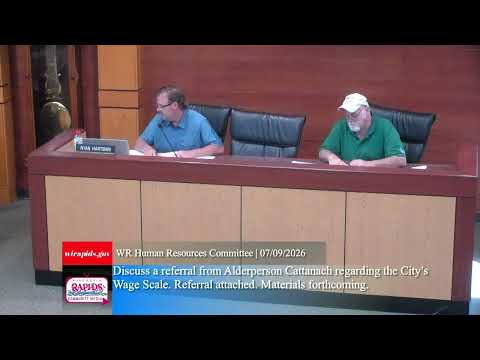
Council refers review of 2024 wage scale to joint finance/property and human resources meeting
Summary
Council members reviewed the 2024 wage scale and a finance analysis showing higher projected costs under the new scale; they voted to refer further study to a joint meeting of finance/property and human resources to determine options for 2027 budgeting and internal equity.
The council discussed a referral on the city's 2024 wage scale and voted to send the matter to a joint meeting of the finance and property committee with the human resources committee for further study.
Human Resources Director Ryan Hartman summarized the 2024 scale, which followed a 2023 salary survey of roughly 38 comparable municipalities and created a 16-step scale intended to recognize experience and market control points. "It was put in place to recognize the experience and longevity of employees here," Ryan said, describing the scale as a recruiting and retention tool.
Ryan reviewed cost projections in the packet prepared with Finance Director Tim DeSorsi. He said that under the previous 2023 system the city would face $279,603 in increases for 2027, while under the current wage scale the estimate was $412,462 (a net difference of $132,859); step increases alone were estimated at $127,551. Ryan said the scale covers approximately 96 to 98 employees and that a typical step increase averages $1,200'$1,400 per person.
A council member noted that suspending step increases and a COLA for 2027 would save roughly $132,000 in the budget but warned of retention risks: "If we were not to do them, we run the risk of losing employees because they're going to go somewhere where they can advance and get a COLA," the council member said.
Members agreed the policy calls for benchmarking every 2'3 years and that now—about 2.5 years after implementation—is an appropriate time to re-evaluate. Ryan said the 3% example was used in the packet because contracts and previous practice had used similar figures, but that annual adjustments could be reassessed.
Chair moved that the wage-scale referral be sent to a joint meeting of the finance and property committee with human resources; the motion (recorded in the minutes as "Motion by Palmquist, 2nd by Fergie") carried on a 3'0 vote.
Council asked staff to provide updated numbers for the 2027 budget cycle and to return findings to the joint committee.