Get Full Government Meeting Transcripts, Videos, & Alerts Forever!
Get email alerts on the Ai Governance topic
No spam. Unsubscribe anytime.
Presenter urges global AI child-safety pledge and calls for ban on 'killer robots' at Geneva dialogue
Summary
At the United Nations Global Dialogue on AI Governance in Geneva, the presenter outlined four priorities — safety, red lines, capacity and transparency — proposed an AI child-safety pledge with three rules, and urged an international ban on lethal autonomous weapons.
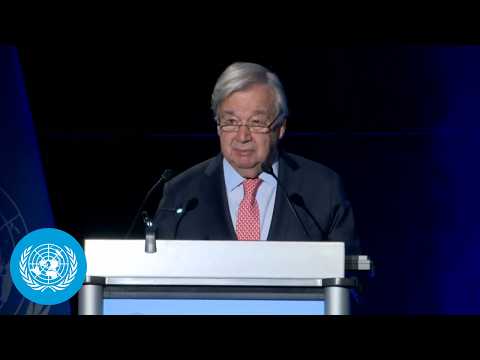
The presenter addressing the United Nations Global Dialogue on AI Governance in Geneva urged countries to adopt an AI child-safety pledge, push for common safety baselines and ban lethal autonomous weapons, saying governance must keep pace with a rapidly spreading technology.
"An experiment is being run on our own societies without a plan and without consent," the presenter said, arguing that AI systems are being deployed faster than institutions and regulators can manage. The speech opened by framing AI as transformative — capable of reshaping economies, healthcare and education — while warning of three scientific risks: speed, concentration of power and threats to truth.
In a detailed set of priorities, the presenter made safety the first priority and proposed an "AI child safety pledge" with three practical rules for any system accessible to children: "Prove it is safe" (independent child-specific safety testing and oversight), "zero tolerance for images of child sexual abuse" (the speaker called for systems to detect, report and remove such content) and that systems must stop and connect a child in crisis to real human support. The presenter said, "No company should deploy an AI system accessible to children without child specific safety testing and independent oversight."
The second priority, the presenter said, is establishing red lines to protect human rights and dignity: "AI must never strip away dignity or entrench discrimination," and in every high-stakes decision — for example in health care or policing — "humans must decide and answer."
On capacity, the third priority, the presenter highlighted a large gap between private and public investment. The address stated private investment in AI infrastructure "approached half $1,000,000,000,000" (figure as stated in the address) while public investment in developing countries remains a small fraction. The presenter said more than 20 member states have nominated centers to a proposed UN-supported global network for AI capacity building and that the speaker would "shortly submit to the General Assembly" recommendations for a global fund to build skills, data and affordable computing power everywhere.
The fourth priority focused on transparency and environmental impacts. The presenter asked major AI companies to publicly disclose the full footprint of their systems — carbon, water and land — and urged companies to commit to powering every data center with renewable energy by 2030. "Data centers already consume more electricity than most countries," the speaker said, and warned the communities hosting that infrastructure are often asked to carry burdens without adequate information or benefits.
Turning to military risks, the presenter warned that civilian AI does not respect a military/civilian line and explicitly singled out small autonomous weapon systems as "killer robots," saying they "must be banned by international law." The speaker called such machines "morally repugnant" and "politically unacceptable."
The presenter thanked the dialogue co-chairs and UN partners — noting ITU and UNESCO's coordination role and the UN Office for Digital and Emerging Technologies — and said the dialogue will continue, be complemented later in the week by the AI for Good Summit in Geneva, and reconvene in New York next year.
The address combined concrete safety proposals with calls for capacity-building, environmental disclosure and arms-control measures; the presenter asked member states to support a UN network, back proposed funds and align on common baselines for testing and accountability. No formal votes or motions were recorded during the speech; the dialogue continues with scientific reports and scheduled sessions later in the week.