Get Full Government Meeting Transcripts, Videos, & Alerts Forever!
Get email alerts on the Open Enrollment topic
No spam. Unsubscribe anytime.
Michigan committee hears divided testimony on bills to require open enrollment statewide
Summary
The House Education and Workforce Committee took testimony on House Bills 53 10–12, which would require districts to participate in open enrollment subject to posted capacity. Parents and local educators warned of lost local control, capacity and special-education strains, while out-of-state and policy witnesses argued the bills would increase access and transparency; no committee vote was taken.
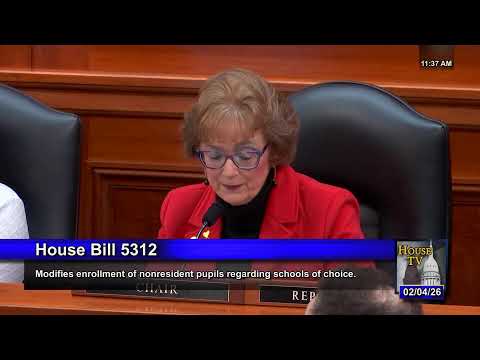
The Michigan House Education and Workforce Committee continued taking testimony on a three-bill package (House Bills 53 10, 53 11 and 53 12) that would require districts to participate in interdistrict open enrollment provided they have available seats. The committee heard opposing testimony from local residents and educators, and supportive testimony from an out-of-state lawmaker and national policy analysts.
John Cotton, a trustee of the Grosse Pointe Public School System speaking for himself, said the bills "would mandate schools of choice statewide" and "strip districts of nearly all discretion beyond capacity," warning the change would disrupt staffing, funding and long-term obligations funded by voter-approved bonds. "This is not a minor policy adjustment as a sweeping structural change to public education in Michigan," he said.
Several Grosse Pointe residents and officials echoed Cotton. Terrence Collins recounted repeated local bond votes, listing past bond amounts and arguing it is "unfair for the people who supported public education in Grosse Pointe with their taxes to be forced to take students who whose parents aren't paying those same high taxes." Annie Monowick, an elementary math specialist and former pupil-accounting auditor with Calhoun ISD, described administrative and fiscal risks, saying year-round, on-demand transfers would greatly increase labor-intensive Section 25e membership transfers and auditing workloads and noting that "house bill 53 10 explicitly states that districts are not required to provide transportation for nonresident students."
Pamela Hornberger, who said she is "no longer a legislator," also opposed the package and highlighted concerns about accountability and services for students with disabilities, saying the bills "do nothing to guarantee that staff would be available in a new district to provide services for her child."
Testimony in favor included Selena Torres Fawcett, a Nevada state assembly member who championed Nevada's open-enrollment law (AB 533). Speaking virtually, Fawcett said Nevada's law broadened options without overwhelming schools where capacity is carefully defined and added that educator partnerships helped the policy succeed there. "Open enrollment allows states to say that you can work here, live where it makes sense for your family, and still choose the public school that best fits your child," she said.
Research testimony added nuance. Jeremy Singer, an assistant professor at the University of Michigan–Flint, summarized studies showing that Michigan's interdistrict choice has not produced large average gains in student achievement and can increase economic segregation in some contexts. Singer warned that geography, transportation and seat caps limit how much open enrollment alone can change educational access, and suggested policymakers consider funding adequacy or boundary changes if the goal is to improve equity and outcomes.
Jude Schwalbach, senior education policy analyst at the Reason Foundation, supported HB 53 10 as a refinement that would standardize processes, require districts to post grade-level capacity, and require the Michigan Department of Education to publish denial counts and reasons. He said the proposal would increase transparency and cited data showing broad participation in open enrollment in many states.
Committee members pressed witnesses on differences between Michigan (more than 800 districts) and smaller-state examples, teacher shortages, how "capacity" would be measured, and whether districts had requested this change. Multiple members said they were not yet inclined to vote and asked sponsors for information about which districts sought this change. The committee read into the record a series of registered positions for and against the bills and adjourned without taking legislative action.
Next steps: no formal committee votes or amendments were recorded during this session; the bills remain under committee consideration pending any sponsor motions or scheduling by chair.