Get Full Government Meeting Transcripts, Videos, & Alerts Forever!
Get email alerts on the Budget topic
No spam. Unsubscribe anytime.
DeKalb County officials say new millage and budget will fund housing bond, pay bump and service investments
Summary
County leaders announced that the Board of Commissioners approved the fiscal 2026 budget and a millage increase they say will fund a first dedicated housing office, a housing investment bond, higher county wages and new investments in health, workforce and animal services.
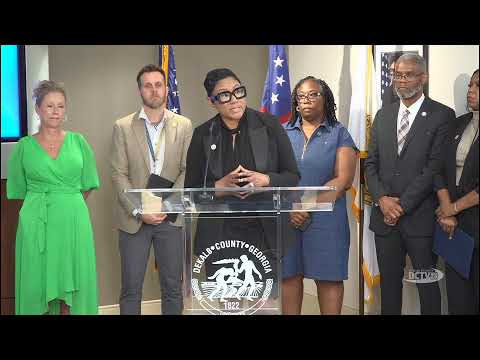
DeKalb County officials announced at a press conference that the Board of Commissioners has approved a fiscal 2026 budget and accompanying millage rate that leaders say will fund a range of new investments, including the county’s first dedicated housing office, a housing investment bond, and an increase in the county employee minimum wage to $19 per hour.
"A budget is a moral document," Lorraine Cochran Johnson, CEO of DeKalb County, said, framing the budget as the result of resident input and a response to declining federal and state support. Cochran Johnson said the approved plan includes an initial $12,000,000 investment to stand up a dedicated housing office and a planned recurring $15,000,000 annual investment beginning in 2027 to expand housing options and reduce homelessness.
Chief Housing Officer Dr. Alan Ferguson said those dollars will underpin a housing investment bond intended to create, deliver and preserve about 15,000 housing units countywide and support programs such as down-payment assistance, owner-occupied rehabilitation, developer incentives and expanded homelessness services. "Those resources are going to provide us an opportunity to launch a number of different programs," Ferguson said.
TJ Sigler, director of the Office of Management and Budget, described the adopted millage as a combination of six fund-specific rates totaling 21.31 mills, up from 20.81 mills the previous year. Sigler said the revenue impact depends on the fund: "A half-mil in [the] general fund would bring in roughly $20,000,000, whereas half a mil in our police services fund would only bring in about $4,000,000," he said. Officials emphasized that the exact revenue depends on tax districts and that staff will publish more detailed figures.
Officials also detailed several other allocations included in the plan: a $2,500,000 workforce development initiative, $600,000 for summer youth employment, and $2,900,000 in health investments that Cochran Johnson said include roughly $1,400,000 for Medcura’s mobile health program and $1,500,000 for Mosaic Health. The plan also includes $1,000,000 for arts programming, $1,000,000 for countywide recycling and a $500,000 contribution to food-security efforts.
Public-safety and employee compensation were highlighted as priorities. Cochran Johnson said the budget supports firefighter recruitment and raises the county’s minimum wage for county employees to $19 an hour "to better recruit and retain" staff. Officials said the general fund will grow from $78,800,000 to $105,200,000 under the adopted plan and that tax fund reserves will rise from $129,800,000 to $155,200,000, steps leaders said will help protect the county’s bond rating.
Commissioner Ted Terry, chair of the Finance Audit and Budget Committee, described the committee’s process as meticulous and said it identified "millions of dollars in cost savings and inefficiencies" that helped fund the new services. Terry criticized federal and state fiscal policy in partisan terms, saying the burden had shifted to local governments, and praised county staff for operational reviews tied to savings.
Animal services also received specific attention: Cochran Johnson announced a $25,000,000 investment for a second animal shelter on the county’s south side. Commissioner Michelle Long Spears said the budget provides $780,000 for programs focused on spay-and-neuter services and for a second facility intended to improve geographic access and partner with Lifeline for operations.
County leaders said they are implementing outcome-based budgeting to link spending to measurable results and are developing a public-facing OpenGov portal to show how funds are being spent and what outcomes are expected. "This year was the first year that we’ve begun implementing our outcome-based budgeting," Sigler said, and officials said they will provide a transparency portal for residents.
During a brief media Q&A, reporter Neomani Watson asked about transparency and revenue. Sigler reiterated the revenue estimates and described the OpenGov portal and outcome-based approach as tools to let residents see where money is going and what it is intended to achieve. Cochran Johnson said a press release with further details would be shared and invited colleagues to follow up on specific program questions.
Officials described immediate next steps as program design, public reporting through the county’s transparency tools and staged rollouts for housing and service initiatives. They said additional details and formal timelines will be published in forthcoming county materials.