Get Full Government Meeting Transcripts, Videos, & Alerts Forever!
Get email alerts on the Buy Down Program topic
No spam. Unsubscribe anytime.
Revere trust details "buy-down" homeownership pilot with 20-year deed restrictions and targeted rollout
Summary
The Revere Affordable Housing Trust Fund Board outlined a pilot "buy-down" program to bridge the gap between market and affordable prices, proposing capped assistance, a deed restriction structure (10 years fully affordable; 11–20 hybrid profit-sharing; expiration at 20 years), and a staged marketing and application plan.
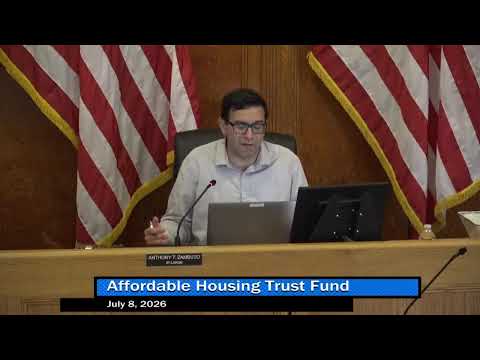
Joe Gravalese, chair of the Revere Affordable Housing Trust Fund Board, presented the board’s proposed "buy-down" homeownership pilot at the July 8 meeting, describing it as a more generous, targeted alternative to the city’s existing $10,000 down-payment assistance.
Gravalese said the buy-down would not subsidize mortgage interest but instead "buy down" the financial gap between a property’s market price and an affordable price for households across a wider AMI range, using a combination of Community Development Block Grant (CDBG) funds, state down-payment assistance funds and Trust dollars. He told the board the program will include a cap on assistance and be structured as a limited pilot rather than an open-ended program.
The draft program design presented ties assistance to a recorded deed restriction. "In the first 10 years of the deed restriction, it's a fully affordable deed restriction," Gravalese said, adding that under the current draft the program would move to a hybrid arrangement in years 11–20 in which sale proceeds would be split between the seller and the Affordable Housing Trust, and the restriction would expire after 20 years. "Money would come back into the trust," he said.
Gravalese emphasized outreach and equity in the rollout: the board would allow a two-month prelaunch marketing window to notify banks, brokerages, schools, the public library, houses of worship and large rental properties; applications would then open on a date the board selects. Applications would be processed on a rolling, first-complete-first-served basis: applicants must submit all required documentation (income verification, mortgage preapproval, proof of residency/connection) to receive a three-month eligibility certificate, which may be extended case-by-case. If an approved applicant’s certificate lapses, a wait list will determine the next eligible candidate. The board proposed Dec. 31 as the last date to issue new eligibility certificates, with certificates running through the end of March for any approvals issued on the final day.
The board discussed program requirements tied to CDBG compliance. Gravalese said properties funded in part by CDBG must meet program inspection guidelines. "We need to make sure properties that we're certifying—especially if they're pre-1978—have their lead paint remediation status clarified," he said. Board member Judy Gosselin added that a Massachusetts law now prohibits accepting a buyer’s waived inspection and noted lead-clearance and specialist reviews are separate from standard inspections; she offered to provide exact compliance details and certification databases to the board.
Gravalese said the Trust will have DPCD (the Department of Planning and Community Development) monitor compliance and that legal staff are drafting the deed restriction language for board review. He also said the program will generally not be stackable with the city’s own $10,000 Trust-funded down-payment assistance for fairness across Trust-funded programs, though it may be combined with outside programs such as MassHousing, federal programs, bank assistance and the North Suburban Consortium down-payment assistance.
Board members asked for practical changes to application materials: embedding a core eligibility table for households of one to four, an upfront checklist for applicants, and translated application materials. Gravalese said translations would be available by default in English, Spanish, Portuguese and Arabic, with additional languages by request via the community ambassador's office.
The board did not vote on the program’s final form at the meeting; Gravalese asked board members to review the deed restriction draft and outreach plan and help make direct contacts to banks and brokerages as the board prepares to finalize the application and launch schedule.