Get Full Government Meeting Transcripts, Videos, & Alerts Forever!
Get email alerts on the Budget topic
No spam. Unsubscribe anytime.
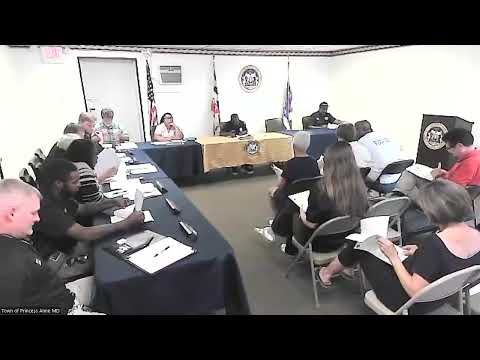
Princess Anne commissioners debate two ARPA budget proposals over small-business grants and town deficit
Summary
Commissioners spent more than an hour weighing two competing ARPA-funded budgets: the administration’s plan that produces a modest surplus and a commissioner-backed plan that increases minority and small-business grants but would create a projected shortfall. The body asked staff to prepare resolutions for the next meeting based on the consensus reached.
Chair called the session to consider two alternate ARPA-based budgets that differ mainly on small-business grant size and deficit treatment. Finance staff said one plan would leave a roughly $79,000 surplus while the other would produce about a $111,000 deficit after ARPA paybacks; commissioners disputed some of the arithmetic but agreed the options had different trade-offs.
Why it matters: The choice will determine whether the town directs more federal recovery money toward larger grants for minority and other small businesses now, or preserves town funds and creates a smaller near-term fiscal impact. Commissioners said the decision affects dozens of local businesses and the town’s short-term reserves.
Finance staff outlined the fiscal mechanics behind the figures and explained how the town borrowed $250,000 earlier in the year and how each budget repays (or spreads) that obligation. "The number that you see on the page where we need to explain what the deficits are are correct," the finance staff said when asked to reconcile differing totals. The administration’s proposal, staff said, converts some ARPA-eligible items into budgeted municipal expenses and leaves a modest surplus; the commissioner-sponsored alternative reallocates more ARPA funds to grants and would require a larger ARPA payback.
Several commissioners and business owners described how grant size matters in practice. One participant identified as a local business owner said larger awards make it possible to "bring on product, to bring on employees," and argued that $10,000 grants would be far more likely to sustain or grow businesses than $2,500 awards. Another commissioner emphasized that the town must avoid even the appearance of conflicts of interest; a commissioner who previously accepted a $2,500 grant read state ethics guidance aloud and said they had recused themselves from the prior related vote.
On procedure, commissioners agreed they only needed a consensus today to tell staff which resolution(s) to draft for the next formal vote when all five members are present. Chair asked for a motion to move forward with the commissioner-backed plan for drafting purposes. A motion was called, and a commissioner reported a motion from Commissioner Jones with a second from Commissioner Johnson; commissioners voiced support and staff said they would record the consensus so the correct resolution could be prepared for the next meeting.
What remains unresolved: Commissioners disagreed on exact surplus/deficit magnitudes, whether permit-fee revenue projections would cover borrowings, and on the practical effect of recusal rules if several commissioners are also business owners applying for grants. Staff said it can draft two resolutions and offered to propose a compromise package mixing elements of both budgets if requested.
Next steps: Staff will prepare resolution language (two drafts to reflect each proposal) for the next agenda and circulate the draft to commissioners before the meeting so they can finalize which version to take to a formal vote when the full commission is present.