Get Full Government Meeting Transcripts, Videos, & Alerts Forever!
Get email alerts on the Wildlife Conservation topic
No spam. Unsubscribe anytime.
Emeritus scientist reports big swings in eared grebe numbers at Mono Lake
Summary
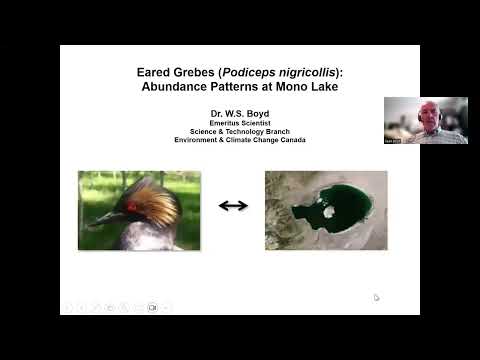
An emeritus scientist with the Mono Lake Committee presented multi-year aerial- and telemetry-based surveys showing dramatic year-to-year swings in eared grebe abundance at Mono Lake, linked to brine shrimp density, algal clarity and El Niño-driven food-web disruptions.
An emeritus scientist with the Mono Lake Committee presented survey and telemetry data showing large year-to-year variation in eared grebe (Podiceps nigricollis) numbers at Mono Lake and argued that changes in brine shrimp abundance and broad climate and lake-elevation drivers explain much of the fluctuation.
The presenter said the situation is unusually concentrated: "it's a unique situation where you have 90% or more of an entire population of 1 species using 2 sites," referring to Mono Lake and Great Salt Lake. He described how grebes use those hypersaline lakes to molt and build the fat and protein reserves needed for long migrations to wintering areas such as the Sea of Cortez.
The talk drew on two types of evidence. The presenter summarized aerial transect counts and photographic surveys—flown at about 1,200 feet above lake level on east–west transects, with roughly 16 transects and a camera firing about every 10 seconds—to produce abundance estimates with an approximate 5–10% standard error. He also described marking and telemetry work that tracked birds from breeding areas in British Columbia to molting lakes.
Those data show both historical highs and abrupt declines. The presenter cited published mid‑October counts from the late 1990s of roughly 1.5–1.6 million birds on the surface, and he reported a roughly 50% drop between consecutive years in one episode that he attributed in part to a "Super El Niño event" and associated food‑web collapse in wintering areas. A repeat telemetry study using the same methods found a strong change between 1996 and 2017: where 50–60% of marked birds were on Mono Lake in 1996, the pattern had flipped by 2017, with 50–60% detected at Great Salt Lake and only 10–20% on Mono Lake.
The presenter linked those swings to brine shrimp availability and water‑quality conditions. He described a "critical density" of brine shrimp identified by Dr. Joe Gell below which grebes will not gain weight, will fail to molt, and will depart early. He said algae blooms that reduce water clarity can compound that problem by making it harder for the visually foraging grebes to find shrimp. The presenter summarized the effect as a "double whammy" in low years: low shrimp density plus low transparency.
Year-specific patterns were highlighted: surveys beginning in 2013 showed a typical mid‑October peak in some years, while 2014–2015 produced fast, early departures associated with very low shrimp densities. The speaker noted several consecutive low years around 2017 and rebounds afterward, with counts in the 2024–2025 period reaching about one million birds on the surface in one October count.
To synthesize drivers, the presenter proposed a "factor web" linking climate warming, snowpack and water exports to lake elevation, which affects salinity, nutrients and algal conditions and therefore shrimp abundance and grebe population health. He said that, according to colleagues, a higher lake elevation "towards the mandated level" would likely improve shrimp abundance and lead to more stable grebe populations.
The presenter also offered methodological context and caveats: survey timing matters (single mid‑October counts can miss patterns), multiple surveys per season provide a fuller picture, and long-term marking every year would be needed to pinpoint when affiliation shifts occurred. He closed by inviting questions.
The presentation did not include formal motions, votes or policy decisions; it focused on scientific monitoring results, hypothesized ecological drivers and implications for lake management and species conservation.