Get Full Government Meeting Transcripts, Videos, & Alerts Forever!
Get email alerts on the Emergency Services Budget topic
No spam. Unsubscribe anytime.
Douglas County officials weigh expansion of mobile integrated health team and billing staff
Summary
Commissioners heard July 8 from Lawrence Douglas County Fire Medical and emergency communications leaders seeking three supplemental positions — an MIH team lead, a third MIH paramedic and an EMS billing specialist — to pilot alternative responses, raise revenue recovery and improve uptime.
Douglas County commissioners heard testimony July 8 from emergency services staff seeking three supplemental positions for Lawrence Douglas County Fire Medical (LDCFM): a Mobile Integrated Health (MIH) team lead, a third MIH paramedic and an EMS administrative (billing) specialist, officials said.
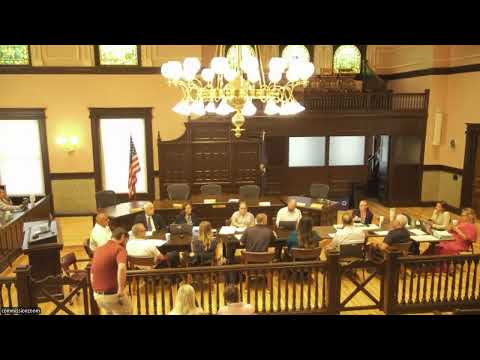
The request came during day 3 of the county’s 2026 budget hearings as staff outlined recent operational data and near‑term priorities. Brooke, a Douglas County emergency services staff member, told commissioners that the Emergency Communications Center handled about 250,000 calls in 2025, of which roughly 46,000 were 911 calls, and said 99% of calls were answered within 20 seconds. John Darling, division chief of EMS at LDCFM, described the supplemental requests as necessary to sustain and expand a two‑person MIH model into a more reliable pilot for alternative, nontransport responses.
Why it matters: Commissioners and staff said expanding MIH could reduce avoidable ambulance transports, improve response reliability in high‑demand periods and give the county better data on whether an MIH‑led alternative response reduces downstream emergency department use. LDCFM leaders said referrals through the MIH program rose about 44% compared with 2024, and that the department handled roughly 12,666 EMS calls in 2025.
What staff asked for and why LDCFM’s three supplemental requests are: (1) an MIH team lead (an IBSC‑certified community paramedic who would provide frontline supervision and cover field duties), (2) a third MIH paramedic to allow standing up parallel MIH teams, and (3) an EMS administrative specialist to improve billing and revenue recovery. Darling said the team lead would be in the field about half the time and that adding a third MIH clinician would raise the MIH team’s field‑availability and allow the county to test alternative response dispatch protocols more often.
On dispatch and the pilot Darling explained the alternative‑response pilot would rely on dispatch "nature" or "determinant" codes: when a 911 call matches a predefined set of low‑acuity determinant codes, dispatch could send the MIH unit as the initial responder rather than automatically sending a fire apparatus or ambulance. "We would put a unit on duty with dispatch ... when we have this 2nd alternative response ... these call types ... we would then send the mobile integrated health team as the primary initial response rather than ... a fire apparatus ambulance," Darling said.
Staff and commissioners emphasized the pilot would be limited and evaluated before any expansion to 24/7 coverage. Darling said the MIH model is intended to be multidisciplinary and to work closely with existing partners — for example, LDCFM already participates in a weekly 'familiar faces' meeting with Lawrence Memorial Hospital and other partners to triage and coordinate care for frequent users of emergency services.
Equipment, vehicles and operations Commissioners asked whether the supplemental requests included vehicles. Darling said one request includes a staff vehicle for the MIH team lead (a non‑response staff vehicle) and the other request covers equipment needed to outfit a second MIH team (cardiac monitor, bags and portable equipment). He cautioned a lower‑certification staffing model (for example substituting an EMT for a community paramedic) would lower service quality and operational flexibility.
Billing specialist: costs and revenue expectations Commissioners pressed whether the proposed EMS administrative specialist would pay for itself. Darling said the position requires training that can take up to a year; his estimate was that efficiency gains and improved collections could offset the cost over time but would not likely generate full payback in year one. One commissioner cited a $75,000 revenue target as illustrative of the scale needed to cover the position; Darling said exact timing and amounts depend on insurer payments and potential state policy changes expanding billability for MIH services.
Staffing, coverage and Station/Medic 6 Staff reported that Medic 6 moved to intermittent staffing January 1 and, after a May recruit graduation, is now staffed full time. Station 5 is the temporary housing point for Medic 6; operations staff said battalion chiefs are empowered to relocate the unit day‑to‑day for event or coverage needs.
Interjurisdictional funding and governance A commissioner asked why the supplemental requests were presented as 100% Douglas County funded when most EMS demand occurs inside Lawrence city limits. Darling said a revised shared expense and EMS governance agreement with the City of Lawrence is under negotiation, and that funding classification could change through that process; because the county’s current governance and budget structure was in place for the hearing, the request was advanced under existing budget lines.
What’s next Staff said county and city leaders continue to negotiate updates to the EMS governance agreement and that budget deliberations will address the supplemental requests. The commission recessed the emergency services segment until 10:05 a.m. and will continue review later in the budget process.
Attributions: Quotes and technical explanations in this article are attributed to Brooke (Douglas County emergency services staff) and John Darling (division chief of EMS, Lawrence Douglas County Fire Medical), both speakers in the July 8 budget hearing.