Get Full Government Meeting Transcripts, Videos, & Alerts Forever!
Get email alerts on the Ulster Delaware Corridor topic
No spam. Unsubscribe anytime.
Consultants present detailed engineering costs, property needs for Ulster–Delaware corridor study
Summary
Tom Baird of Barton & Lejudice told the Ulster County Housing & Transportation Committee on July 2 that three build alternatives were engineered with itemized costs and property-acquisition estimates; the study flags wetlands and Army Corps jurisdiction as permitting risks and schedules design and permitting at 2–3 years.
Tom Baird, a consultant with Barton & Lejudice, told the Ulster County Housing & Transportation Committee on July 2 that a feasibility study of the Ulster–Delaware corridor provides engineering-level cost estimates and identifies property-acquisition and permitting challenges for three alternatives: a trail-only option, a rail-only option and a dual rail-with-trail option.
Baird said the study produced detailed quantities for earthwork, rock removal and structure work rather than “rough numbers,” and that estimates use prevailing wages and recent contractor bids. He gave headline figures in 2030 dollars: roughly $4.0 million for the trail-only option, about $4.45 million for rail-only, and approximately $16.3 million for the rail-with-trail alternative. He told the committee, “They weren't rough, rough numbers. This was really looked at in very much detail.”
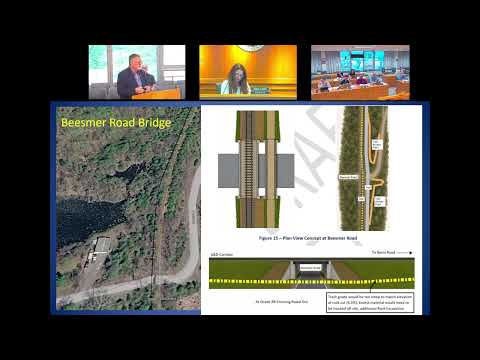
The presentation described several cost drivers that could affect any option. Baird said filling and earthwork for one constrained section amounts to tens of thousands of cubic yards (he cited about 25,000–27,500 cubic yards of fill for a particular reach and roughly 18,200 cubic yards of rock removal in a rock-cut area). He highlighted a recommended pedestrian bridge at Bisma Road with a quoted cost of about $1,100,000 (excluding contingencies and inflation), which the study inflates to roughly $1.4 million in the overall estimate for that connection.
Property acquisition is a central uncertainty. Baird and county staff identified eight to nine parcels in the Route 28 area with unclear title or historic right-of-way claims; the report estimates about $18,000 per parcel to cover purchase price plus title work, surveys and legal fees in the county’s approach. Baird noted those figures include contingencies for additional parcels and legal complexities; he said the study assumes some acquisitions will be fee-simple transfers when heirs or unclear ownership require it, while other corridors may be handled by easement.
Environmental and permitting issues also shaped the cost picture. Baird said the corridor contains an unnamed stream that likely falls under U.S. Army Corps of Engineers jurisdiction and that the study includes line items for water-protection measures and possible stream relocation where the railroad- or trail-alignment approaches wetlands. He told the committee a formal Corps determination will require a field visit and written jurisdictional decision. Director Doyle said having the feasibility study completed will make the county more competitive when seeking federal and state implementation funds, and will shorten the permitting and grant-application timelines.
On materials and reuse, Baird said all existing rail ties would be removed and accounted for in disposal costs; the team assumed reuse of some higher-quality recycled ties where feasible and built both removal and replacement costs into the budget. He reported a unit-cost comparison used in the study of roughly $50 per recycled tie versus $90 for a new tie in the cost model, and said about 10% of rail would need replacement under both trail and rail options.
Committee members asked detailed follow-ups during a question-and-answer period. Legislator Kovacs sought clarification on the per-parcel $18,000 estimate and whether it included acquisition price; Baird confirmed it did. Vice Chair Sperry asked about schedule, and Baird replied that a federally funded, typical permitting-and-design process for a rail-with-trail project could take two to three years with construction phases following — roughly a five-year timeline overall — and that locally funded alternatives could move faster. Geotechnical questions from Legislator Murray were answered by reference to soil surveys and photographic verification included in the report.
Baird said the full draft will be released to the committee and that the study includes an open comment section; he offered to respond in writing to submitted questions. The committee was also reminded of a corridor walk scheduled for July 13 (rain date July 20) at which Baird will accompany legislators to review corridor conditions in the field.
What’s next: the county will release the draft report for review and accept written comments; additional analysis (title searches, Corps jurisdictional determinations and detailed design surveys) will be required before any formal acquisition or construction actions begin.