Get Full Government Meeting Transcripts, Videos, & Alerts Forever!
Get email alerts on the Water Policy topic
No spam. Unsubscribe anytime.
State Water Board details two alternative compliance paths for urban water‑use objectives
Summary
The State Water Resources Control Board outlined two alternative compliance pathways under the "Making Conservation a California Way of Life" regulation: a 30% pathway requiring stronger annual reductions and AWWA G480‑20 verification, and a 20% income‑based pathway with lower annual reduction targets and fewer requirements.
The State Water Resources Control Board on a public webinar explained two alternative pathways suppliers may use to comply with tightening urban water‑use objectives set under the "Making Conservation a California Way of Life" regulation, adopted in July 2024 and effective Jan. 1, 2025.
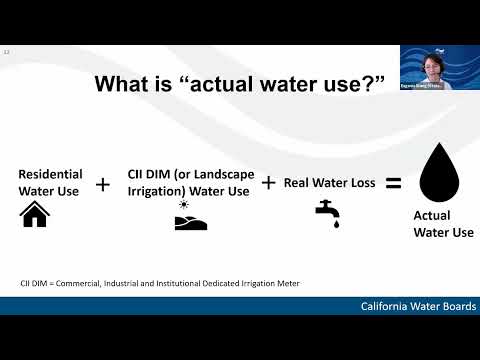
Eugenia Wong, an environmental scientist with the State Water Resources Control Board, said the regulation requires suppliers to meet calculated urban water‑use objectives, implement performance measures for commercial, industrial and institutional (CII) use, and file annual reports. "Alternative compliance specifically refers to alternative pathways to compliance with the supplier's urban water use objective," Wong said.
The regulation offers a 20% pathway and a 30% pathway. Kyle Mulro, also an environmental scientist at the board, described eligibility and effort differences: the 20% pathway requires suppliers to show a baseline reduction need of at least 20% to reach a projected 2040 objective and that the service‑area median household income is lower than California's averaged MHI; the 30% pathway requires a baseline reduction need of at least 30% but does not use an income threshold.
Both pathways require suppliers to develop, post to a public website and implement a conservation plan. Annual per‑capita reductions must be documented: suppliers on the 20% pathway must demonstrate an annual per‑capita reduction of at least 1%, while the 30% pathway requires at least 2% per year. Wong said conservation plans for the 20% pathway should aim to meet objectives by June 30, 2041 unless staff approves a different date.
Mulro reiterated how eligibility is calculated: the baseline is the average water use for fiscal years ending 2024, 2025 and 2026 and eligibility is always measured against that baseline. In an example presented by Mulro, a supplier with a baseline of roughly 3.01 billion gallons and a 2040 objective of about 2.6 billion gallons would need a 33% reduction and thus be eligible for the 30% pathway.
For suppliers pursuing the 30% pathway, the board requires verification of adherence to the American Water Works Association G480‑20 guidance. "The G480 is a water conservation and efficiency program standard," Peter Mayer, who helped develop the G480, said. Mayer noted the G480 series is voluntary generally but that the board is using the 2020 edition (G480‑20) as the referenced checklist for the 30% pathway; a 2025 edition exists but the 2020 version is the one currently specified in California legislation.
Guest presenter Moe Erbeznick of MEA Consulting urged utilities to "know your numbers," listing the state data sources that populate the urban water use objective report (electronic annual reports for population, Department of Water Resources aerial measurements for land area, LAM Explorer and SAFER monthly submissions for CII and monthly use, DWR weather stations, and water loss audits). He recommended that suppliers validate measurements, apply for variances where applicable (seasonal population, evaporative coolers), confirm dedicated irrigation meters by 2028, and prioritize programs that target the largest opportunities for savings.
Mulro summarized submission requirements: one‑time items include the percent‑reduction calculation (both pathways), service‑area MHI documentation for the 20% pathway, and the G480 checklist for the 30% pathway; the conservation plan must be posted publicly. Annual per‑capita reduction calculations are required each year. Mulro said the board will release a prefilled Excel form later this year to help suppliers submit baseline and 2040 objective data, conservation plan links, MHI where applicable and G480 verification where required. He added there is no fixed deadline to begin submitting alternative compliance materials and that the baseline years remain fixed.
The webinar concluded with a resource list (fact sheet, FAQ, and the water conservation inbox) and moved to a Q&A session; organizers said the recording and slides would be posted on the board's website. "The video and slides will be available after this presentation is over," Mulro said.