Get Full Government Meeting Transcripts, Videos, & Alerts Forever!
Get email alerts on the Municipal Finance Public Safety topic
No spam. Unsubscribe anytime.
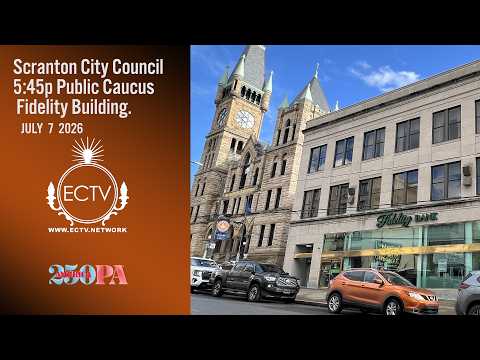
Scranton caucus presses administration on Fidelity building purchase and real-time crime center plans
Summary
City officials told councilors the city plans to buy the Fidelity Bank building next to City Hall to create an accessible customer service hub and an administrative real-time crime center for the police department. Officials outlined retrofit and operating costs, funding sources including state and federal grants, and pledged more information before any lease decisions for the third floor.
Scranton city officials briefed councilors at a caucus Tuesday evening on plans to purchase the Fidelity Bank building next to City Hall and to convert part of it into a police administrative hub and a real-time crime center.
Eileen Cipriani, the city’s business administrator, told councilors the move is driven by two long-standing problems: the historic City Hall cannot be made economically ADA-compliant, and the police department has outgrown its administrative space. “The city looks at this opportunity next door with Fidelity Bank right next door to City Hall to ensure the city's footprint for future generations,” Cipriani said.
Chief Carroll described the police use: the annex would house an administrative hub and a permanent real-time crime center that aggregates video, data and partner inputs during large events and critical incidents. “This starts small, and this is stuff we are already doing, and we need to grow,” Carroll said, adding that the center would improve field support and event response.
Deputy Chief Laffrey explained that patrol and detectives will remain at the operations site while records, training and other administrative functions would occupy the annex. Lieutenant Pappas outlined administrative responsibilities—records, training, fleet and reporting—that the new space would better accommodate.
Officials gave councilors an estimated $75,000 for move-in retrofit work and said an immediate sidewalk leak repair was estimated at about $3,000. The department provided an annual operating estimate of roughly $101,000, which a city staff member broke down into repairs, elevator share, monitoring and other line items; Cipriani said the $200,000 retrofit line is already in the capital budget and that parts of the funding will come from closed special-cities accounts, federal funds, an interfund transfer, and about $400,000 from labor and industry dollars moved into capital.
Councilors pressed for clarity on the third floor, where officials said there are no current firm leasing agreements but that the city may pursue tenants or community partners to offset operating costs. One councilor objected to learning of potential leasing through a press report; several asked that council be given advance notice and materials before items appear on the public agenda.
Councilors also asked about alternatives. Carroll said adding offices to the current police garage or using the Sorenti Center were not cost-effective or suitable; engineers’ estimates for a garage-plus-offices option would approach the millions, he said. Officials emphasized that the annex would use existing swipe-card security, add two secured egress doors and restrict access to criminal-justice data on the second floor.
On funding, Cipriani and Carroll described two separate grant streams: a PCCD state grant of about $250,000 for recruitment and retention and a federal community appropriation (COPS) application for police technology—described in discussion as a $500,000 award—used to cover technology purchases and to help offset costs; officials noted reimbursement processes can take time and that the city is advancing necessary work to allow police to use equipment during the grant reimbursement process.
Councilors raised operational concerns for customer-facing services: code enforcement, LIPs and treasury functions are heavily used by residents and will have staffed representation at the annex’s front desk, officials said. Councilors urged that process improvements and better responsiveness accompany any move, citing complaints about delayed inspections and permit closures.
Cipriani said the purchase closing was mutually pushed from July 1 to Aug. 1 because the parties needed more time, and she warned that if the transfer is not approved the city risks losing its deposit of $188,000. The figures discussed in the caucus included a purchase price line and the deposit; officials explained that some numbers, and how lines were moved between rehab and purchase in prior budget amendments, would be summarized for council review.
The caucus concluded without a formal vote; councilors were told the transfer and related ordinance will appear on the upcoming public agenda for formal consideration. Council adjourned the caucus at 6:53 p.m.; a regular meeting was scheduled to begin at 7:05 p.m.