Get Full Government Meeting Transcripts, Videos, & Alerts Forever!
Get email alerts on the Economic Development topic
No spam. Unsubscribe anytime.
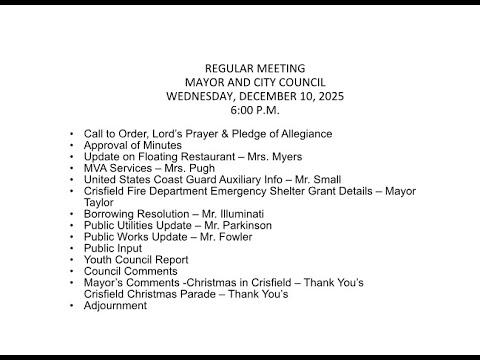
GCAC outlines hurdles for floating-restaurant idea, urges marketing and regulatory help
Summary
Francis of the Greater Crisfield Arts Council summarized meetings with local restaurant owners and regulators, saying equipment costs, health-code uncertainty, staffing and low off-season traffic are the main barriers; GCAC recommends marketing support, a regulatory manual and investor outreach to pursue floating-restaurant concepts.
Francis, representing the Greater Crisfield Arts Council (GCAC), told the mayor and council that two recent outreach efforts — meetings with local restaurant owners and a regulatory symposium — showed strong interest in a floating-restaurant concept but flagged several practical obstacles.
"The challenges they had in common included the cost of equipment, of shipping, things like hoods and fryers and sprinkler systems," Francis said, adding that operators also complained about what they called a lack of transparency on non–food-safety requirements from the health department. She said labor shortages and customer-volume thresholds make it hard for year-round operation.
GCAC contracted the Bosserman Center at Salisbury University to facilitate owner meetings and gather data that Francis said could be used to better target promotions. She recommended the city and GCAC produce workshops or a municipal "manual" that lists regulatory steps and contact points so prospective restaurateurs are not surprised by permitting requirements.
On the floating-restaurant idea, Francis said critical-area rules complicate the plan: regulators generally treat a floating eating establishment as moveable only if it can be propelled under its own power, and the city may have limited authority to grant variances depending on site and structure. She noted county zoning appears to prohibit use of shipping containers as permanent restaurant structures and that fire-safety and building-code standards are hurdles for container-based concepts.
Mayor Darlene Taylor thanked Francis and asked what the committee’s next steps would be; Francis said GCAC will continue to identify interested operators and to coordinate with tourism, planning and the real-estate community to find investors and potential sites.
The council did not take formal action on the concept at the meeting; Francis asked council members to refer interested investors to GCAC for follow-up.