Get Full Government Meeting Transcripts, Videos, & Alerts Forever!
Get email alerts on the Contract Oversight Shelters topic
No spam. Unsubscribe anytime.
Councilors press Urban Alchemy and city staff on grievance tracking, hiring and procurement
Summary
Portland Solutions and Urban Alchemy briefed the committee on grievance processes after public allegations about Urban Alchemy staff; Portland Solutions described a Smartsheet tracker and a severity scale, and Urban Alchemy outlined new intake channels and staffing changes. Councilors sought procurement records, police‑notification data and clearer reporting metrics.
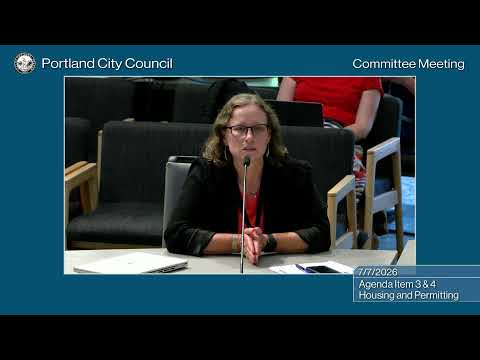
Portland Solutions and contracted operator Urban Alchemy appeared before the Housing and Permitting Committee on July 7 to explain how complaints and allegations at city-funded shelter sites are handled and to answer councilors’ questions about procurement, staff screening and the adequacy of grievance reporting.
Hank Smith, deputy director of Portland Solutions, said the city’s shelter services team manages 16 shelter and day-center locations and has worked to improve grievance tracking in recent months. “We created this tracker in March 2025,” Smith said, referring to a Smartsheet log used to centralize complaints, and noted the team formalized a 1–5 severity scale in May 2025. Brandy Westerman, Emergency Humanitarian Operations Director, said the city conducts weekly syncs with Urban Alchemy and biweekly meetings with the city ombudsman to coordinate investigations and that every complaint is investigated.
Urban Alchemy leaders accepted responsibility for prior lapses in tracking and described concrete changes. Behron Wilson, chief operating officer, and Louie Hammonds, vice president of operations, said the operator now offers six intake channels (QR code, paper forms, verbal intake assisted by staff, drop boxes, phone and email), routes complaints through a Zendesk ticketing system, aims to acknowledge grievances within five business days and to resolve cases within 10 working days, and has assigned a dedicated grievance coordinator. Ian Clark Johnson, Urban Alchemy’s chief of human resources, said employee-relations investigators handle more serious allegations and that substantiated misconduct can result in retraining or termination.
Public testimony during the Urban Alchemy portion was mixed. Peggy McDaniel, a homeowner who serves on the Clinton Triangle community oversight committee, urged continued support for Urban Alchemy while stressing that accountability matters. A current shelter guest, Robert Powers, said Urban Alchemy helped him secure documentation, employment and imminent permanent housing. Other speakers asked how the city ensures complainants are protected from retaliation and whether some low‑barrier models need different oversight.
Councilors focused on several recurring concerns. Vice Chair Green pressed staff on procurement and the RFP history, noting that only a small set of providers applied for large alternative-shelter contracts; Portland Solutions said four organizations were awarded alternative-shelter contracts in the most recent RFP cycle (Urban Alchemy, Sunstone Way, Salvation Army and Cultivate Initiatives), and acknowledged that Sunstone Way subsequently closed a site. Councilors also asked for data on how often police were contacted in response to complaints; Portland Solutions agreed to provide that reporting to council members who requested it.
Members raised the risk of underreporting. Councilors sought assurances that participants know they may contact the city or the ombudsman directly rather than only reporting to the operator, and asked for measures that reduce barriers to reporting from people with limited access to email or phones. Brandy Westerman said the city and ombudsman have run outreach sessions at shelter sites and that Portland Solutions’ team performs regular on-site monitoring to ensure grievance contact information is posted and visible.
On hiring practices, Urban Alchemy described a multi-step interview process, background checks and an introductory 90-day period during which new staff are evaluated and may be separated if concerns arise; the operator said felony sexual‑assault convictions would disqualify a candidate. Councilors asked how the operator vets staff transferred from other jurisdictions when allegations exist elsewhere; Urban Alchemy said the particular allegation circulated in the media was raised after a staff member relocated and that an independent investigation led to separation of that employee.
What’s next: Councilors and staff agreed to continued oversight. Portland Solutions said the city auditor is performing a program-level performance audit, and city staff committed to provide procurement records, complaint-tracking data (including police notifications) and other records requested by councilors as they consider procurement and contract decisions ahead of the next budget cycle.