Get Full Government Meeting Transcripts, Videos, & Alerts Forever!
Get email alerts on the Lake Management topic
No spam. Unsubscribe anytime.
Select Board backs continuing lake harvester while seeking state clarification on permit language
Summary
The Stockbridge Select Board voted to continue mechanical harvesting of invasive plants in the Stockbridge Bowl under the town’s historical interpretation of its permit while it asks Natural Heritage supervisors for a definitive reading of a contested “one pass” restriction.
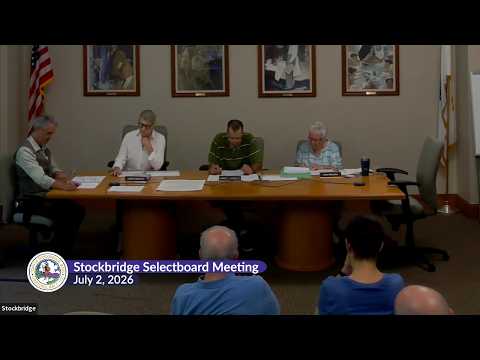
The Stockbridge Select Board voted on July 2 to continue mechanical harvesting in the Stockbridge Bowl while the town seeks clarification from the Natural Heritage & Endangered Species Program (NHESP) about whether the town’s permit allows one pass per cutting event or only one pass per season.
Michael (Chair, Stockbridge Bowl Stewardship Committee) told the board the committee had prepared a lake management plan drafted by consultant GZA, which he said cost $55,000, and that the plan provides a roadmap for prioritizing invasive-plant control, dredging and other restoration actions. “GZA wrote it up, cost us $55,000,” Michael said, recommending that the board adopt the plan as a town document to aid future permitting.
The stewardship committee and staff described current control efforts that include mechanical harvesting of Eurasian water milfoil, targeted removal of water chestnuts (a prior campaign removed 29 in one year, according to the report) and a joint funding arrangement with the Stockbridge Bowl Association. The committee said it was evaluating supplemental techniques including diver-assisted suction harvesting (DASH) and noted a $15,000 grant used for water chestnut control.
Staff raised a permit issue after NHESP staff questioned how the town had been reporting “one pass” areas. NHESP’s initial interpretation, conveyed in email, was that “one pass” means one pass per season; town staff and the committee said the town’s longstanding practice and past permit reporting treated “one pass” areas as subject to one pass per cutting event (frequent cuts during summer). Staff said legal counsel confirmed NHESP had not issued an order to stop harvesting but the difference in interpretation could affect how often the harvester is used.
Sally Underwood Miller (member, Stockbridge Bowl Stewardship Committee) and conservation advocates told the board that harvesting is critical to lake health and that past monitoring did not show a decline in native invertebrates from harvesting. “The harvesting of the Eurasian milfoil is critical to the health of the lake,” Sally said, noting that biomass removal reduces nutrient recycling that can fuel cyanobacteria blooms.
After discussion about enforcement roles (monitors can inform visitors but police handle enforcement), a motion by a committee member to continue harvesting under the town’s historical interpretation and to escalate the question to NHESP supervisors (named in the transcript as Jesse Medick and Rebecca) passed on a voice vote. The board directed staff to press for a definitive interpretation from NHESP and to pursue additional review through legal and state channels as needed.
The board’s decision preserves ongoing removal work this summer while the town seeks clarity from state regulators. The stewardship committee said it will continue monitoring, provide hard copies of the management plan for board review, and follow up on outstanding questions about the Lily Brook watershed study and dredging permitting.
The board did not adopt the lake management plan at this meeting; committee members said they will return with hard copies and requested the item be scheduled for a future meeting.