Get Full Government Meeting Transcripts, Videos, & Alerts Forever!
Get email alerts on the Public Safety Training topic
No spam. Unsubscribe anytime.
Plan commission backs Mid State's "Nexus" public-safety training center; conditional-use permit also approved
Summary
The Stevens Point Plan Commission on May 4 recommended approval of Mid State Technical College's conceptual plan for a regional public-safety training complex called the Nexus and approved a conditional-use permit for a campus on a roughly 36-acre city-owned parcel near Badger Avenue. Supporters highlighted workforce benefits; alder and commissioners pressed for operational agreements, tax/TIF clarifications and mitigation conditions.
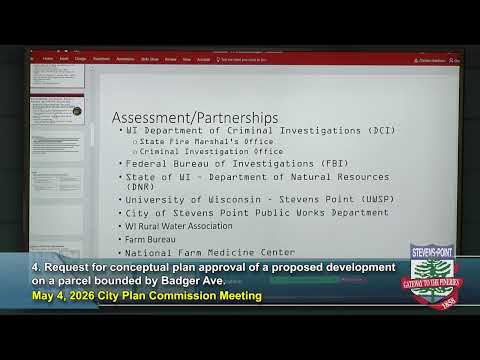
The Stevens Point Plan Commission voted May 4 to recommend approval of Mid State Technical College's conceptual plan for a regional public-safety training complex the college calls the Nexus and then approved a conditional-use permit to allow an educational facility on a roughly 36-acre city-owned parcel near Badger Avenue.
Benjamin Nuss, dean of Mid State's Stevens Point downtown campus, introduced the proposal and turned the presentation to Mid State president Dr. Shelly Mandyk, who said the college has already raised about $23 million from roughly 180 businesses, more than 130 individuals and eight municipalities toward a multi-year capital campaign. "We raised $23,000,000," Mandyk said, describing broad regional backing for training that Mid State estimates would serve agencies across eight counties.
Mandyk described the Nexus as a shared training complex for fire, EMS, police and corrections with classrooms, labs, a community conference space and shared decontamination and locker facilities. "It's going to be called the Nexus," she said, adding that the facility is intended to centralize public-safety training while retaining and expanding the decentralized sites Mid State already operates.
Stevens Point's fire leadership said the proposed Station 3 and training co-location respond to documented response-time gaps on the east side of the city. The chief told commissioners that "currently, we do not service anything east of Interstate 39 within the department's four-minute response-time goal," and that the proposal would place additional engines and a truck company to reduce those gaps.
Supporters from regional partners spoke during the public hearing. Kurt Hoyer, director of law-enforcement academies at Mid State, read a statement of endorsement on behalf of a regional supplier, and Keri Panovich, Aspirus Southeast division president, said the training center would strengthen emergency-response skills and patient outcomes.
Not all public comment was uniformly positive. Andrea Olsen, District 4 alderperson, urged the commission to weigh trade-offs before endorsing the project, noting the city parcel's status in a TIF district and saying "this is about $800,000 worth of property that will now be tax exempt if this occurs." Olsen asked for an operational agreement to be in place before fundraising advances and expressed concern about the short public-notice window on the item.
Mid State and city staff responded to concerns in real time. Mandyk told commissioners that the state's 16 technical colleges serve their local districts and that the Nexus would focus on regionally identified needs rather than duplicate specialized programs held elsewhere. The fire chief said the city's existing training site at Whiting Avenue would be returned to Public Works for city use when the Nexus opens, and staff emphasized that both conceptual plan approval and conditional-use authorization are preliminary steps: site-plan review, detailed operational agreements and any required permits will be considered in later proceedings.
Commissioners pressed for conditions and clarifications on maintenance, co-management and mitigation measures such as an acoustic berm and screening along residential edges. Adam (community development staff) described the multi-step land-use process ahead, including site-plan review and any additional code requirements.
After the discussion, Commissioner Schueller moved to recommend approval of the conceptual plan; the motion was seconded and carried by unanimous voice vote. The commission then opened the conditional-use hearing for the educational facility; no additional speakers stepped forward, a motion to approve with staff conditions was made and the conditional-use permit was unanimously approved.
Next steps: staff and the applicant will return to the commission and the common council with site-plan materials, operational agreements and the detailed conditions recommended for final approval. Mandyk said Mid State expects to launch a capital campaign in the fall and estimated a multi-year fundraising horizon, while continuing to work with the city on logistics and mitigation.
What the commission recorded: conceptual-plan recommendation and conditional-use approval (voice votes). The approvals were for the preliminary land-use steps only; final site plans, permits and any intergovernmental or operational agreements were not adopted tonight.
(Reporting note: quotes and factual details are drawn from testimony and staff presentations at the May 4 Plan Commission meeting.)