Get Full Government Meeting Transcripts, Videos, & Alerts Forever!
Get email alerts on the Agriculture Winery Corridor topic
No spam. Unsubscribe anytime.
Monterey County staff previews Agricultural and Winery Corridor Plan ahead of August hearing
Summary
County planning staff gave an informational workshop on the Agricultural and Winery Corridor Plan (AWCP), explaining permit pathways, development limits and next steps; commissioners pressed for clarity that the plan not favor wineries over other agricultural uses and asked about school and pesticide concerns.
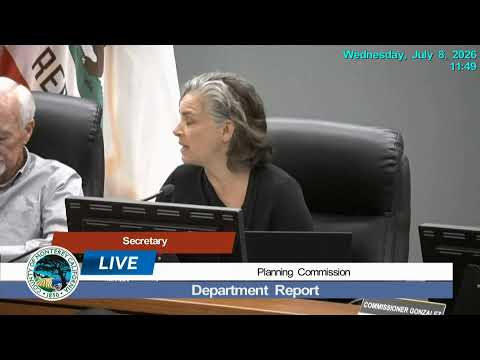
County planning staff on July 8 gave an informational briefing on the Agricultural and Winery Corridor Plan (AWCP), describing the plan area, permit pathways and development standards ahead of an August public hearing and implementing ordinance.
The commission heard from assistant planner Katie Scarry and principal planner Sarah Weichal that the AWCP covers three segments — River Road, Malone Road and Metz Road — and was adopted as part of the county's 2010 General Plan to encourage viticultural and related uses in targeted unincorporated areas of Monterey County. "This is simply an informational presentation," Scarry said, and staff noted the informational work qualifies for a CEQA feasibility/planning exemption under CEQA Guidelines section 15262. Staff said the implementing ordinance and zoning-clearance chapter will return to the commission on 08/12/2026.
Why it matters: the AWCP would create streamlined, site-specific rules for tasting rooms, artisan wineries and related visitor-serving uses while setting limits intended to protect agricultural land and the county's rural character. Staff described allowable facilities and permit levels: a maximum of 10 new full-scale wineries across the corridor (5 on River Road, 2 on Metz Road and 3 on Malone Road), with ministerial permits available for many winery-adjunct uses and administrative permits required for larger on-site facilities. Development standards in the draft include a 5-acre minimum parcel size, a 30% maximum building-site coverage, typical setbacks and a structure-height limit of about 35 feet (with certain allowances up to 45 feet); event thresholds, parking expectations and review by sheriff, fire and public-works staff were also discussed.
Commissioners pressed staff for broader context and equity across agricultural sectors. Commissioner Deal (Diehl) and others urged that the implementing ordinance explicitly preserve opportunities for non-viticultural operations — for example, allowing strawberry tastings, artisan cheese sales and other farm-based visitor uses on terms that do not favor wineries alone. Staff said the AWCP is limited to the plan area and to the scope of the 2010 environmental analysis, but that the implementing ordinance's language and outreach will be prepared to address concerns raised by growers and other stakeholders.
Public comment from Norm Groot of the Monterey County Farm Bureau said the Farm Bureau is "completely engaged" and generally supports the draft plan, but requested clarification of specific permit language. Groot noted apparent tension in the draft between a 1,500-square-foot kitchen/dining-area limit and the practical needs of larger events such as wedding receptions, asking for clearer wording for event-related facilities. He also observed that pesticide regulation is governed by state law and warned against duplicative county standards.
Staff response and next steps: staff said the Agricultural Advisory Committee's recommendations were reviewed and incorporated where appropriate and that the August 12 implementing-ordinance hearing will include additional detail and outreach (staff cited prior outreach to the Farm Bureau and the availability of an AAC representative with wine-industry experience). The commission did not take formal action at the workshop; staff will return with a draft implementing ordinance and materials describing permit thresholds, any proposed changes to LUAC forms, and a description of how agencies such as the agricultural commissioner and school districts will be notified during implementation.
What remains unresolved: commissioners asked staff to clearly explain why specific numeric limits (for example, the 1,500-square-foot kitchen/dining cap and minimum parcel sizes) were chosen and to identify how school-siting or pesticide concerns would be handled in the implementing ordinance. Staff said it will return with more detailed findings, sample permit language and outreach plans ahead of the August hearing.