Get Full Government Meeting Transcripts, Videos, & Alerts Forever!
Get email alerts on the Tax Policy topic
No spam. Unsubscribe anytime.
Granville board continues tax‑policy work session, debates role in economic development
Summary
At a July work session, consultant David Conley reviewed tax instruments and urged a cautious, evidence‑based policy; board members discussed TIFs, NCAs, JEDs and tradeoffs between property and income tax while agreeing to circulate a plain‑language draft and keep a 90‑day review safeguard.
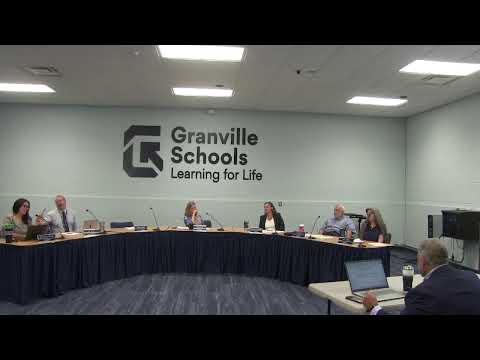
The Granville Exempted Village School District Board of Education held a special work session to continue drafting a tax policy and to talk through how the district should engage with local economic development proposals. David Conley, the session presenter, led a review of revenue tools and policy options.
Conley opened with a brief overview of the district's current tax mix, noting that property taxes, an income tax the district renews periodically and a PI levy together provide routine revenue growth. "You do not need an income tax right now," Conley said, emphasizing that an income tax is one of several options rather than an immediate requirement.
The core of the meeting centered on whether and when the board should participate in local incentive packages such as tax‑increment financing (TIF), community reinvestment areas (CRA), joint economic development districts (JED) and new community authorities (NCA). Conley and multiple board members urged that the district treat each request case‑by‑case and press local governments and developers to justify proposed infrastructure costs. "If they're using what would have been our revenues to incent growth, what do we receive in return?" Conley asked, recommending that the district seek measurable benefits rather than assume it will be held harmless.
Board members described ongoing coordination with municipalities (Union Township, Granville Township, Granville Village, McKean Township and Newark Township) and cited past projects where infrastructure (water, sewer) determined whether development proceeded. Several members said the district's strong academic reputation is an economic asset that can be part of negotiations with prospective employers or developers.
The presenters and members reviewed specific tools. They described JEDs as mechanisms that extend income‑tax capture across boundaries (focused on employee wages, not property tax), NCAs as entities that can impose fees on new homeowners that may act as a backstop, and TIFs as vehicles that divert future tax increments to pay for infrastructure. Conley warned that if a TIF's projected infrastructure costs are not transparent, the district can be left without a fair share of resulting surplus revenue.
The board also discussed longer‑term revenue choices tied to outstanding debt. Conley reported roughly $3,000,000 per year in bond service that will drop to about $1,000,000 in 2029 and end in 2031. He said the board could allow property taxes to fall accordingly, issue a new bond (he outlined a hypothetical $55,000,000 no‑tax‑increase bond using existing debt service), or pursue a quarter‑percent income‑tax increase that would generate roughly the same revenue as the bond payoff.
Members debated the equity implications of income vs. property tax, including the impact on fixed‑income homeowners, and noted the technical difficulty of explaining percentage‑based changes to voters. The discussion also referenced the so‑called 20‑mill floor as a comparative policy target (participants phrased it as a 'mill floor' concept the board could target or approximate), while repeatedly noting that any state or constitutional changes would affect feasibility.
On process, Conley recommended concrete safeguards for the policy: a 90‑day waiting period for complex incentive requests, annual financial benchmarks and a requirement that administrators report tax‑base shifts to the board. He also urged the board to write the policy in plain language so residents can understand tradeoffs and to circulate the draft for edits before the next meeting. The board agreed to receive the cleaned‑up draft and provide comments ahead of the next session.
The board did not take formal votes during the work session; members scheduled a follow‑up draft review meeting. The next work session was set for July 17 at 5:00 p.m., when members will go page‑by‑page through the circulated draft.