Get Full Government Meeting Transcripts, Videos, & Alerts Forever!
Get email alerts on the Food Waste Management Capacity topic
No spam. Unsubscribe anytime.
MassDEP convenes organics panel to map capacity gaps and policy options for food‑waste diversion
Summary
Massachusetts Department of Environmental Protection convened a panel of composters, depackagers and digester operators to discuss closing an estimated ~270,000‑ton management shortfall to meet the state’s 2030 food‑waste diversion target; panelists agreed on outreach, zoning fixes and incentives but differed on the role of anaerobic digestion.
John Fisher, a MassDEP organizer, opened the organic subcommittee meeting by framing the agency’s 2030 goal of diverting 780,000 tons of food waste annually and noting Massachusetts had diverted about 370,000 tons as of 2024. He told attendees MassDEP is pursuing a technology‑agnostic approach to permitting and grants aimed at growing capacity and reducing disposal of food material.
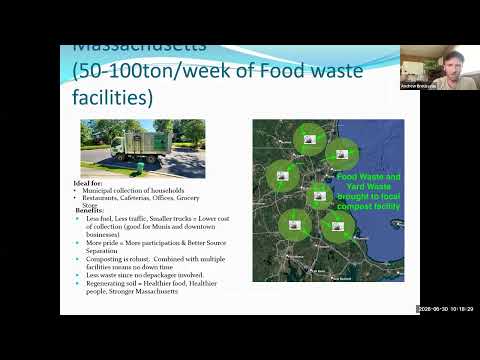
A six‑person panel of operators and service providers described the current system and where additional capacity is needed. Black Earth Compost’s Andrew said decentralized composting—many smaller facilities placed near residential generators—lowers collection costs and helps keep contamination low. He reported Black Earth operates four facilities with roughly 340 tons per week of food waste throughput and about 170 tons per week of spare capacity across sites.
Bright Feeds’ chief growth officer, Lakshmi Wurdam, described a manufacturing facility in Berlin, Connecticut (permitted ~450 tonnes/day) and a transfer and depackaging station in Oxford, Massachusetts (permitted ~300 t/day and operating at roughly half capacity). Wurdam said Bright Feeds focuses on drier pre‑consumer material and uses drying technology to produce animal feed that meets nutritional and moisture specifications.
Representatives from Circular Services Group and Vanguard Renewables described two different but complementary roles: large‑scale depackaging plus anaerobic digestion (AD) on the one hand, and farm‑based digesters that convert food plus manure into renewable natural gas and fertilizer on the other. Diverse Inc. (Chris Thomas) argued mechanical depackaging and robust permitting are necessary to process heavily packaged food at industrial scale while limiting contamination of end products.
Panelists converged on several implementation barriers: municipal uncertainty about future requirements and program costs (carts, liners, staffing), limited availability of appropriately zoned or affordable land for composting, contamination risk when expanding to many small generators, and the economics of collection and haul. Operators urged clearer policy signals—phased thresholds for generator bans, streamlined and flexible grant administration, and regionally coordinated procurement to strengthen end markets for compost and soil amendments.
A point of contention centered on market dynamics between composting and AD. Andrew (Black Earth) warned that favorable energy subsidies and higher tip‑fees for digesters can allow some haulers to undercut nearby composters by hauling material longer distances to AD facilities, which risks degrading local composting markets and nutrient recycling. Divert/Circular speakers countered that digestion recovers large volumes of water and energy while producing soil amendment and liquid fertilizer, and that well‑operated digesters use covered systems and monitoring to limit fugitive methane.
MassDEP staff explained how waistband inspections and enforcement currently work: inspections at solid‑waste facilities look for banned materials in loads and enforcement typically targets generators (not residents); previous practical thresholds (1 ton to ½ ton per week) were conservative because food is sometimes dispersed or liquefied in loads. Fisher said lowering thresholds could be done but would likely be phased with outreach and different operational approaches for enforcement against smaller generators.
Participants recommended practical municipal steps to start programs: subsidized pilot cohorts to build route density (municipalities paying the first 500–1,000 households), school and community education, better alignment between boards of health, DPW and town zoning, and grants targeted toward start‑up equipment and collection logistics. Several panelists urged interagency coordination (DEP, MDAR, DOER and others) to identify land and streamline siting and permitting.
Fisher closed by saying MassDEP will compile chat questions and panelist input, include contact information in the meeting materials, and continue the subcommittee’s series, with the next meeting expected in September as MassDEP develops the updated Organics Action Plan. The meeting produced clear consensus on outreach, pilot programs, grant flexibility and procurement to grow end markets; it also surfaced competing views about how to use market levers to balance composting, AD, depackaging and animal feed as complementary pathways.
The meeting recorded no formal votes or regulatory decisions; MassDEP said further stakeholder engagement and follow‑up sessions will shape any proposed rule or threshold changes.