Get Full Government Meeting Transcripts, Videos, & Alerts Forever!
Get email alerts on the Agriculture topic
No spam. Unsubscribe anytime.
Monterey County reports $4.82 billion in 2025 crop value; strawberries top $1 billion
Summary
Monterey County Agricultural Commissioner Juan Hidalgo released the 2025 crop report reporting $4.82 billion in gross production value (a roughly 3% drop from 2024). Speakers highlighted strawberries and leaf lettuce as top commodities, noted pest and market pressures, and raised organic-practice trends and conversion barriers.
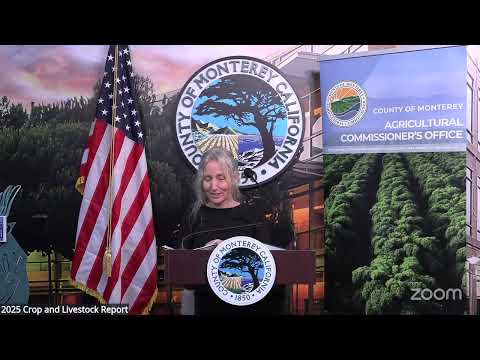
Monterey County Agricultural Commissioner Juan Hidalgo on the annual crop report said the county's 2025 gross production value was $4,820,000,000, a decline of about 3% from 2024, while strawberries and leaf lettuce again each topped roughly $1 billion in farm-gate value.
"Strawberries hold the number 1 spot again this year, surpassing $1,000,000,000 in gross production value," Hidalgo said, noting the county's mild climate and fertile soils and citing roughly 56,000 agricultural workers who help harvest the county's diverse commodities.
Norm Groot, executive director of the Monterey County Farm Bureau, praised the report's summary of crop diversity but warned of rising costs. "Fully 13% of our production costs now go to regulatory programs in California. That's about $1,600 per acre each year," Groot said, calling shrinking margins a persistent challenge for local operations.
Hidalgo outlined other sector pressures: wine grapes saw a roughly 25% decline in gross production value to about $114,000,000 in 2025, which he attributed to decreased consumer demand and lower yields; brassica growers faced significant damage from diamondback moth; and lettuce producers experienced an uptick in impatiens necrotic spot virus (INSV).
The commissioner also cited trade headwinds: fluctuating tariffs in the prior year coincided with a roughly 25% drop in total exported pounds of county commodities in 2025 compared with 2024, a trend Hidalgo said affected growers by increasing import-related input costs.
Jody Raymond of the California Strawberry Commission highlighted the crop's wider economic role, noting California produces the bulk of U.S. strawberries and stressing partnerships with Cal Poly and the University of California on research and sustainable practices. "For every farm dollar, 95¢ of that is reinvested back into the community," Raymond said, and she recognized the role of women farmers in the industry.
On organic production, speakers said the report highlights 25 years of national organic standards and Monterey County's certified-organic program. Hidalgo said organic crop values are about 18% of the county's total production value and that organic acreage has more than doubled over the last decade, though acreage can fluctuate year to year.
During a short media question-and-answer session, Hidalgo said the county does not operate a program to subsidize organic certification; instead, state and U.S. Department of Agriculture cost-share programs can help with first-year certification costs. He also identified land availability and the three-year organic transition period as principal barriers for farmers considering conversion.
The event closed with thanks to industry partners and county staff for compiling the report and working with growers to ensure accurate data. The county did not take any formal actions or votes at the event.