Get Full Government Meeting Transcripts, Videos, & Alerts Forever!
Get email alerts on the Fair Housing topic
No spam. Unsubscribe anytime.
Arlington Human Rights Office details fair‑housing enforcement, testing and outreach
Summary
Anna Maynard of Arlington County's Office of Human Rights explained how the county enforces its human rights ordinance for housing, described intake and investigation benchmarks (about 6–9 months on average), outlined recent fair‑housing testing with the Equal Rights Center, and promised greater outreach to landlords and partners.
At a Tenant‑Landlord Commission briefing, Anna Maynard, a staff member in Arlington County's Office of Human Rights, reviewed the office's enforcement role on fair housing, described how complaints are taken and investigated, and outlined recent training and testing partnerships.
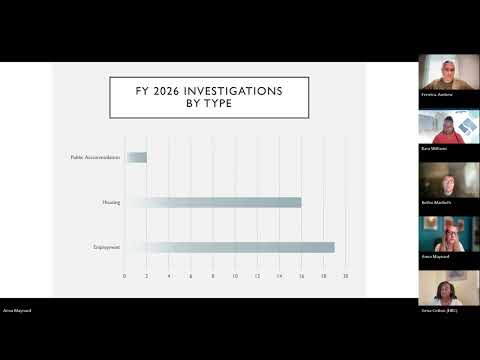
Maynard said the office enforces Chapter 31 of the Arlington County Code on matters including employment, housing, public accommodation, commercial real estate and credit, and that fair‑housing jurisdiction applies to dwelling units with four or more units when one is not owner‑occupied. "We are neutral fact finders and decision makers. We don't represent either side," she said, describing the office's intake and investigative process.
Why it matters: commissioners pressed whether Arlington's ordinance offers protections comparable to neighboring jurisdictions. A committee member argued Arlington currently provides "weaker protections" than some peers and urged the office and County Board to pursue alignment with state and federal law. Maynard responded that fair housing is a priority for her office, that the ordinance was last updated in 2023–24 (adding a source‑of‑funds basis), and that changes would require County Board action and coordination with the county attorney.
What the office does: Maynard walked commissioners through the complaint lifecycle. Complaints are typically submitted through an online portal (Spanish form available), followed by an intake interview with an investigator. If accepted, investigators draft and serve a complaint on the respondent, allow a 30–45 day response window, gather documents and witnesses, and issue a detailed written investigative report. "That process takes a few months usually," she said, adding that "an average complaint takes 6 to 9 months or so" and the ordinance requires completion within one year.
Remedies and limits: The office favors conciliation and settlement when appropriate to make complainants whole; remedies can include reasonable accommodations or policy changes. Maynard said compensatory (not punitive) relief is possible but the office cannot award attorney fees. She also noted statutory limits: the ordinance generally requires complaints be filed within 180 days of the last alleged discriminatory act.
Testing, training and outreach: Maynard described year‑to‑date fair‑housing testing and a new training component conducted with the Equal Rights Center; testing is ongoing and Maynard said results are expected in the fall. She said the office is expanding outreach—attending housing fairs, coordinating with the Department of Human Services and CPHD, and planning presence at the County Fair—to reach both housing providers and residents. Maynard agreed to explore recurring landlord workshops (semiannual or similar) and to coordinate with Lucy Yon's quarterly landlord engagement forum.
Scope questions raised by commissioners: Commissioners asked whether Arlington is structurally equipped to pursue rapid enforcement similar to Fairfax County (which has a separate fair housing code). Maynard said the Human Rights Office does not have authority to halt evictions; other county agencies may intervene in eviction or housing‑stability matters. She welcomed cross‑agency coordination to fill enforcement or service gaps.
Claims and responses: A committee member asserted Arlington's ordinance "offer[s] weaker protections" than state and federal law and urged the office to prioritize updates. Maynard said the office takes fair housing seriously, is discussing internal ideas to expand scope, and offered to bring the subject to the Human Rights Commission and Fair Housing Committee for consideration.
Next steps: Maynard said the office will complete its current testing and prepare a report to share with commissioners, will coordinate outreach with CPHD and DHS about July 1 state law changes and landlord notification, and will discuss potential ordinance updates with commission bodies—while noting any formal change requires County Board action.