Get Full Government Meeting Transcripts, Videos, & Alerts Forever!
Get email alerts on the Licensing topic
No spam. Unsubscribe anytime.
Community board denies Nightingales request to expand liquor license after residents report late-night disturbances
Summary
Community Board 2 voted to deny Nightingales request to upgrade to a full-liquor license and extend weekend hours after residents and the board raised noise, private-party and proximity concerns; the owner disputed the allegations and said the venue has added soundproofing. The board recorded a 7-to-1 denial with one abstention.
Community Board 2s SLA committee voted to deny a package of changes sought by Paragion Huvela Singhs Avion LLC (operating as Nightingale at 37 Carmine Street), rejecting a requested class change to a full-liquor license and weekend-hour extensions after lengthy public comment and committee questioning.
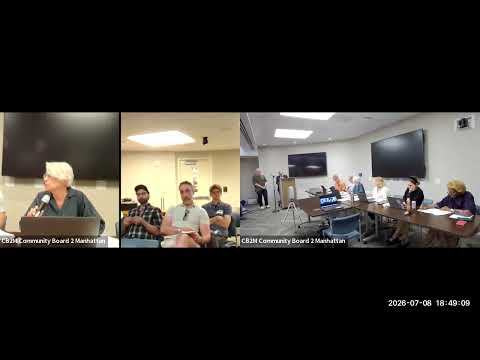
The committees chair, Donna Ratri, opened debate by noting the board had previously advised against a full-liquor license at that residential location and that the State Liquor Authority had imposed stipulations when it issued the existing tavern license. After nearly three hours of testimony and public comment the committee recorded a 7-to-1 vote to deny the applicants requested changes; one member abstained.
Neighbors described repeated late-night disturbances they said were linked to the business. Rebecca, a 30-year resident who said her apartment shares a party wall with the premises, told the committee: "I could hear [the bar] blasting; I went into the bar and told them to turn it down." She said private events have continued past midnight and described a January incident in which a patron urinated at her front door.
Owner Frank said he had invested in soundproofing and denied systematic violations. "We have not served an ounce of alcohol after midnight since the ruling," he told the committee, and said photographic and point-of-sale records could disprove specific late-service allegations. He said the business has roughly 113 signatures in support and that most neighbors endorse the venue.
The committee also debated a statutory 500-foot proximity rule to a nearby church. Members asked the applicant to produce a definitive survey and evidence of which church doors are regularly used; one committee member said that, if a regularly used church entrance fell within the measured radius, a full-liquor license would be barred by statute.
David Gruber, president of the Carmine Street Block Association, and other supporters urged the board to give the business a chance, arguing the venue has community support and improves street safety. Gruber said he had met with the owner and asked only that the operator keep noise and private-party impacts under control.
After weighing conflicting testimony about past late-night events, the board concluded the package as presented raised unresolved public-interest issues (noise management, clarity about private events and statutory buffer measurements). The chair read the result as a denial; the transcript shows the tally as seven members voting to deny, one abstention.
The committee told the owner he may return with more narrowly tailored requests or additional documentation, such as a church letter clarifying which doors are regularly used for congregant entry and objective POS or camera evidence resolving disputed late-night dates. The denial applies to the current package as presented to the board; the applicant may reapply.