Get Full Government Meeting Transcripts, Videos, & Alerts Forever!
Get email alerts on the Governance topic
No spam. Unsubscribe anytime.
AFPIF advisory board adopts governance and procedural plan unanimously
Summary
At an extraordinary meeting, the AFPIF advisory board voted unanimously to adopt a governance and procedural plan that sets out member roles, review processes, conflict-of-interest rules, and public-record procedures; members discussed executive sessions, applicant feedback, and next steps including an Aug. 26 meeting to prepare the first RFA.
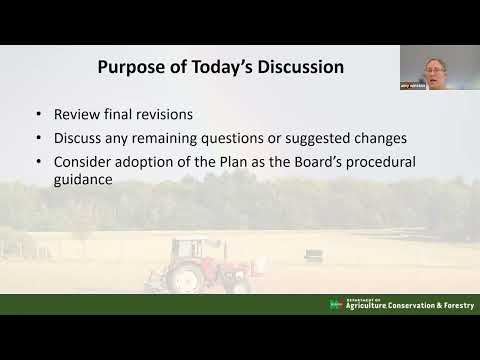
An extraordinary meeting of the AFPIF advisory board concluded with members adopting a governance and procedural plan designed to guide how the fund will operate, review grant applications and make funding decisions.
"This is iterative. It's a living document," said Lily Kenny, a staff member who presented the draft and led the review, noting the plan draws on models such as Vermont's Working Lands and other state funds. The plan lays out the board's mission and organizing principles, member expectations, definitions, and the division of responsibilities between the department that administrates the fund and the advisory board that sets strategic priorities.
Co-chair Sarah Littlefield opened the formal vote. "Would someone like to make a motion?" she asked. Amy Winston moved to adopt the governance and procedural plan; Krista West seconded. The board voted by a show of hands and the motion "passes unanimously," the co-chair said.
The plan clarifies the department's administrative role — eligibility screening, financial review and preparation of board packets — while reserving final funding decisions to the board. "It's the board that is the final decision maker, not the department," Kenny said when asked what would happen if the board disagreed with a departmental recommendation.
Members also discussed when the board should use executive session to protect proprietary information. "The law covers what can be discussed in executive session and why we move into them," co-chair Craig Hickman said, stressing statutory limits on confidential discussion and that final votes must occur in public.
Several members raised operational questions the board said could be resolved in future guidance or in the RFP process. Murata Cook asked whether applicants would receive scoring feedback; members suggested committees, department staff, or contracted technical-assistance providers could offer feedback or referral to support underserved applicants. The group also discussed whether certain nonprofit-led shared-use projects should be treated as eligible; members noted waivers or RFP-specific language could accommodate such cases.
The full plan also includes conflict-of-interest rules requiring disclosure of direct and perceived conflicts and guidance on recusals, public-notice and recordkeeping requirements, and an appendix on metrics and evaluation to track participation and outcomes.
Kenny said she will post the updated plan to a SharePoint site and the board's website and will circulate the final version after today's meeting. The board scheduled its next meeting for Aug. 26 to discuss non-procurement-sensitive aspects of the first solicitation and next steps for the inaugural RFA.
The motion to adopt was made by Amy Winston and seconded by Krista West; the board adopted the governance and procedural plan by unanimous show-of-hands vote and then adjourned.