Get Full Government Meeting Transcripts, Videos, & Alerts Forever!
Get email alerts on the Great Hill Stockpile topic
No spam. Unsubscribe anytime.
State agency proposes soil removal and stabilization after stockpiled fill encroached on Great Hill Drive wetlands
Summary
The state agency overseeing Burnell Hall renovations told the Bridgewater Conservation Commission it will push back and stabilize a soil stockpile that partly encroaches on the wetlands buffer, remove presumed contaminated buffer material, and install erosion controls; commissioners pressed for soil testing and an RDA filing.
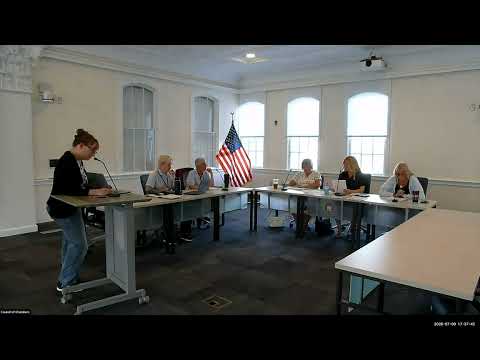
Ryan Moore, first deputy general counsel for the Division of Capital Asset Management and Maintenance, told the Bridgewater Conservation Commission on June 25 that the agency intends to remedy a stockpile at Great Hill Drive that the commission flagged in a June 8 cease-and-desist letter.
"There is absolutely no malice involved in this project at worst. It was an unintentional oversight to encroach on the buffer zone area at Great Hill Drive," Moore said, offering a slide set that traced most of the soil to a retention basin near Burnell Hall and outlining a multi-step remediation plan. Moore said the agency's calculations show "between 7 and 800 cubic yards" of material at the storage area and that only about "10 feet or so of the soil pile" is presently encroaching into the 100-foot wetlands buffer.
DCAM's proposed remedy includes moving the stockpile back roughly 33 feet to create an additional 10-foot "buffer zone to the buffer zone," removing sediment from a concrete swale, excavating and off-hauling four inches of material from the immediate buffer zone, placing 4 inches of clean loam, hydroseeding the area, and installing straw wattles and silt fence. The agency said it will regrade slopes to 3:1, add soil tackifiers to limit runoff, and install an asphalt curb to divert roadside flow away from the restored area.
"We're going to presume that that buffer zone contains some low impact hazardous materials and haul all of that away, and then put 4 inches of loam down in that area," Moore said, adding that the agency's construction manager did not observe visual or olfactory signs of contamination at the source site but that the top material near the road can contain roadway wash-off.
Commissioners and staff welcomed many elements of the plan but pressed DCAM for more testing to determine whether the primary stockpile material is safe to remain on-site after stabilization. Chair Marilyn McDonald said she needs "to know what's in them" before concluding whether material could be reused on-site or must be disposed off-site; she and other commissioners asked for an RDA with Tier 1 RCS sampling results at standard minimal detection limits.
Moore acknowledged the commission's concerns and said DCAM would work with the commission on an RDA and would off-haul material the agency presumes to be impacted. The commission also arranged a joint site visit with MassDEP wetlands and solid-waste staff and DCAM representatives to inspect the stockpile and the adjacent berm; staff scheduled that coordinated visit for July 21.
What happens next: DCAM said it will return with more formal filings and the commission requested that sampling and an RDA be submitted quickly. The commission emphasized that any material found to exceed acceptable criteria must be removed to an appropriate facility.