Get Full Government Meeting Transcripts, Videos, & Alerts Forever!
Get email alerts on the Marine Geology topic
No spam. Unsubscribe anytime.
Researchers map major summit rebuild at Northwest Rota 1 after 2025 Nautilus survey
Summary
Oregon State scientists and Ocean Exploration Trust processing of EV Nautilus multibeam data found a new summit cone and apparent lava flows at Northwest Rota 1; researchers say the summit rose from roughly 550 m depth to about 450 m and have submitted an NSF proposal for ROV sampling.
Oregon State University researchers and Ocean Exploration Trust said post‑cruise processing of multibeam sonar from the 2025 EV Nautilus cruise revealed substantial geomorphic change at the Northwest Rota 1 seamount in the Mariana Arc, evidence the volcano has recently rebuilt its summit and produced broad lava flows.
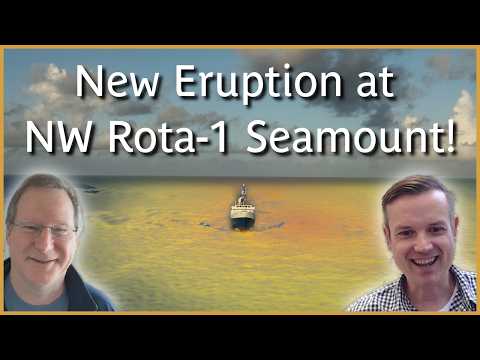
"We have a before and after map of the volcano, and we can see that there's huge changes," said Bill Chadwick, a research associate at Oregon State University in Newport. Chadwick and co‑author Jeff Beeson, an assistant professor in Oregon State’s College of Earth, Ocean, and Atmospheric Sciences, said the differenced maps show a new summit cone and a lumpy ridge trending west that looks like thick lava flows.
"Northwest Rota 1 was the first place we ever saw a deep‑sea volcanic eruption on the planet," Chadwick said, citing the seamount’s active history beginning in 2003 and continuing through about 2010. Beeson said the 2025 Nautilus transit recorded a water‑column anomaly — bubbles and venting — and that the full extent of seafloor change only became clear after the team returned to Oregon and reprocessed the multibeam data. "We transited over it, and there was a water column anomaly in the multibeam data that indicated that there was at least some bubbles and some venting," Beeson said.
Chadwick summarized the principal quantitative observation: "So there's a big new cone at the top. The summit is now, you know, is 550 meters before. It's now 450 or so." The researchers characterized those depth numbers as approximate and said sampling will be needed to confirm the deposits’ composition and emplacement mechanism.
The team also highlighted biological observations. Video from a Japanese ROV cruise that made a single dive after the mapped change showed specialized vent shrimp still present on the seafloor despite the new deposits, suggesting some organisms persisted through the event.
To follow up, Chadwick and Beeson said they have submitted a proposal to the National Science Foundation to fund a return cruise with a remotely operated vehicle to collect samples and make direct observations at the seafloor. "We want to go back there and make some dives and collect some samples," Chadwick said. The researchers also urged any vessels operating in the Marianas to resurvey the area when possible so more time‑series data can be assembled.
Beeson and Chadwick described the project as a valuable student training opportunity: undergraduates and graduate students assisted in processing multibeam data, differencing grids and producing figures for the short paper documenting the change. The hosts noted the broader community benefit of continuously collecting mapping data during transits, which can identify unanticipated sites for further study.
Ocean Exploration Trust said it will be in the Marianas region again in summer 2026 and provided nautiluslive.org for updates on future expeditions. The researchers said determining whether the observed deposits are lava flows or fragmental material will require ROV sampling and laboratory analysis before they can explain why the volcano reawoke.
The paper documenting the mapping change is the subject of the interview and the team has solicited interest from other research vessels and collaborators for follow‑up work.